
200+ Science Words That Start With Y With Simple Meanings & Examples
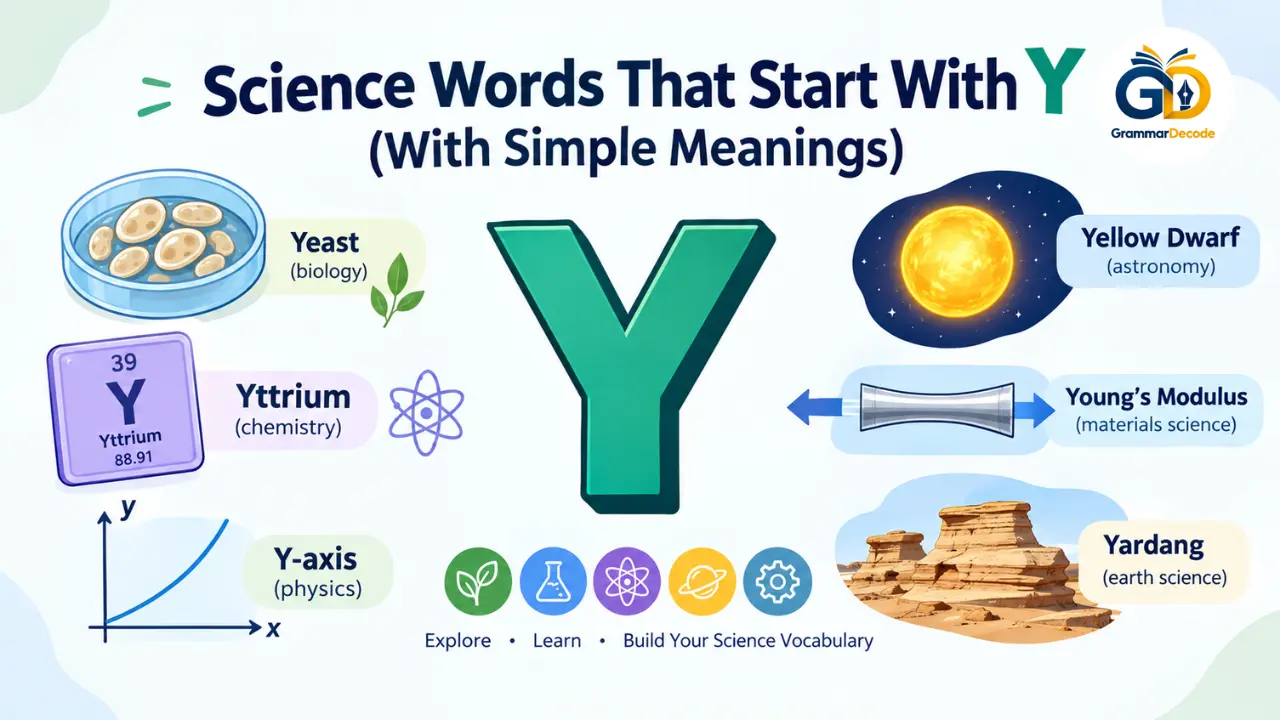
Science words that start with Y include terms from biology, chemistry, physics, astronomy, mathematics, and engineering. Examples include yeast, a type of fungus; yttrium, a chemical element; Y-axis, a coordinate axis used in graphs; and Young’s modulus, a measure of material stiffness.
This glossary organizes scientific vocabulary by subject and explains each term in simple English. Some words are used across several fields, while others belong to specialized areas of science. The goal is to help students and curious readers understand both the meanings and the contexts in which these terms are used.
Common Science Words That Start With Y
The following quick-reference table introduces several recognizable science words beginning with Y.
Read: 20 Other Ways to Say Focus | Focus Synonyme With Examples
Quick List of Y Science Words and Their Meanings
| Word | Scientific field | Simple meaning |
|---|---|---|
| Yeast | Biology | A type of fungus, often made up of a single cell. |
| Yolk | Biology | The nutrient-rich part of an egg that supports embryo development in many animals. |
| Y chromosome | Genetics | One of the human sex chromosomes, carrying genes involved in sex development and other functions. |
| Yersinia | Microbiology | A genus of bacteria that includes species capable of causing disease. |
| Yttrium | Chemistry | A chemical element with the symbol Y and atomic number 39. |
| Ytterbium | Chemistry | A metallic chemical element in the lanthanide series. |
| Yttria | Materials science | A common name for yttrium oxide, a compound used in specialized materials. |
| Ylide | Chemistry | A type of chemical species with oppositely charged atoms, often discussed in organic chemistry. |
| Yield | Chemistry | The amount of product obtained from a process or chemical reaction. |
| Young’s modulus | Physics | A measure of how stiff a material is when it deforms elastically. |
| Yield strength | Materials science | The stress level associated with the onset of permanent deformation in a material. |
| Yield point | Materials science | A point on a material’s stress–strain behavior associated with yielding. |
| Yaw | Physics and engineering | Rotation or angular movement around a vertical axis, depending on the reference frame. |
| Yaw rate | Engineering | The rate at which an object changes its yaw angle. |
| Y-axis | Mathematics | The vertical axis in a standard two-dimensional coordinate graph. |
| Y-intercept | Mathematics | The point where a graph crosses the y-axis, when such a crossing exists. |
| Young’s double-slit experiment | Physics | An experiment demonstrating interference patterns produced by waves of light. |
| Yardang | Geology | An elongated landform shaped mainly by wind erosion. |
| Yellow dwarf | Astronomy | A traditional descriptive term for certain yellowish main-sequence stars, including the Sun. |
| Young stellar object | Astronomy | A star in an early stage of formation or evolution. |
| Yarkovsky effect | Planetary science | A small force caused by the uneven emission of thermal radiation from a rotating body, which can change its orbit. |
| Yerkes Observatory | Astronomy | An astronomical observatory in Wisconsin, United States. |
| Yellowcake | Nuclear science | A concentrated uranium-bearing material produced during uranium processing. |
| Yolk sac | Developmental biology | An embryonic structure involved in early nourishment and development, with functions that vary among animals. |
How Scientific Words Beginning With Y Are Used
These terms describe several different kinds of scientific ideas. Some name living organisms or biological structures, such as yeast and the yolk sac. Others identify elements and chemical species, such as yttrium and ylides. In physics and engineering, words such as yaw, Young’s modulus, and yield strength describe motion or material behavior.
Other terms are used in mathematics and astronomy. The Y-axis helps locate points on graphs, while a young stellar object refers to a star at an early evolutionary stage. Understanding the scientific field behind a word makes its definition easier to remember and apply correctly.
Why Do Science Words Starting With Y Matter?
Learning scientific vocabulary helps students understand textbooks, laboratory instructions, diagrams, and classroom discussions. Even a short term such as yield can have a specialized meaning in chemistry that differs from its everyday use.
Scientific words also connect related subjects. For example, Young’s modulus is useful in physics and engineering because it describes a material property, while the Y-axis appears in mathematics, data analysis, and scientific graphs. Learning these words in context makes technical information easier to interpret.
Biology Words That Start With Y
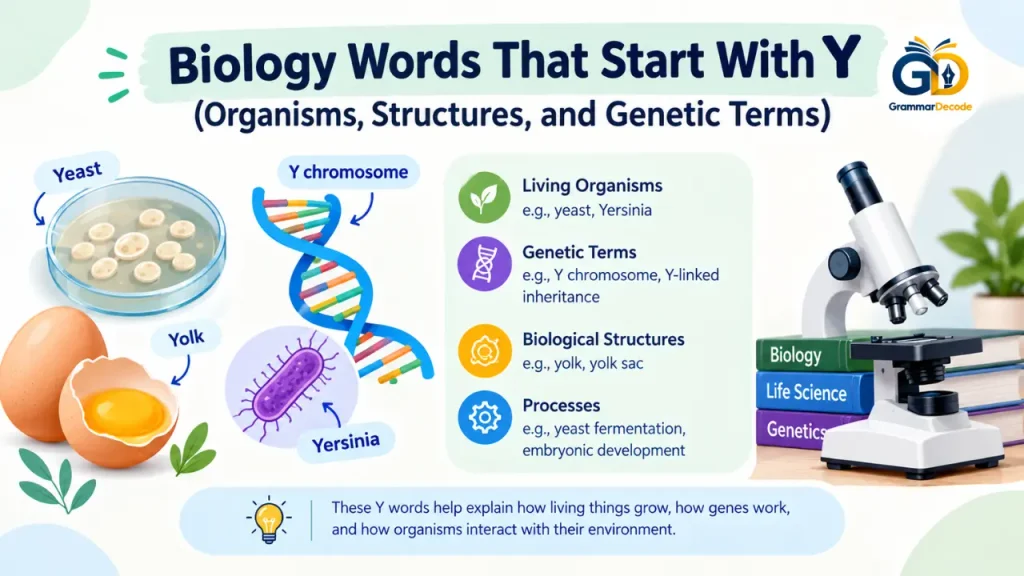
Biology includes words beginning with Y that describe fungi, reproductive structures, genetic material, and microorganisms. Some are familiar everyday words, while others appear mainly in genetics, microbiology, and developmental biology.
General Biology and Life Science Terms
| Word | Simple meaning |
|---|---|
| Yeast | A fungus that includes many single-celled species. Some yeasts are used in baking and fermentation. |
| Yeast cell | An individual cell belonging to a yeast organism. |
| Yeast colony | A visible group of yeast cells growing together on a suitable surface or culture medium. |
| Yeast fermentation | A metabolic process in which certain yeasts convert sugars into products such as ethanol and carbon dioxide. |
| Yeast metabolism | The chemical reactions through which yeast cells obtain energy and build or maintain cellular components. |
| Yolk | The nutrient-rich part of an egg that supports development in many egg-laying animals. |
| Yolk protein | A protein found in egg yolk that contributes to nutrient storage. |
| Yolk sac | An embryonic structure involved in nutrient transfer and early development; its precise functions differ among animal groups. |
| Yellow fever | A viral disease transmitted to people by infected mosquitoes in certain regions. |
| Yersinia | A genus of bacteria that includes Yersinia pestis, the bacterium that causes plague. |
Genetics and Microbiology Terms
| Word | Simple meaning |
|---|---|
| Y chromosome | One of the human sex chromosomes. It carries genes involved in sex development and other biological functions. |
| Y-linked inheritance | Inheritance of a genetic trait associated with a gene on the Y chromosome. In typical inheritance, a father can pass such a gene to a son who inherits his Y chromosome. |
| Y-linked gene | A gene located on the Y chromosome. |
| Y chromosome gene | Another way of referring to a gene found on the Y chromosome. |
| Y chromosome variation | Differences in DNA sequence or structure among Y chromosomes in different individuals. |
| Y chromosome analysis | Examination of Y-chromosome DNA for research or applications such as tracing certain paternal-line relationships. |
| Yersiniosis | An infectious illness caused by certain bacteria in the genus Yersinia, commonly involving the digestive system. |
| Yersinia pestis | The bacterial species responsible for plague. |
| Yersinia enterocolitica | A bacterial species that can cause intestinal infection in humans. |
| Yersinia pseudotuberculosis | A bacterial species that can cause infection in humans and other animals. |
Biology Words for Students
If you are beginning to learn biology, start with terms that connect easily to familiar objects and processes.
- Yeast: A fungus used in some foods and fermentation processes.
- Yolk: A source of nutrients for a developing embryo in many animals.
- Yolk sac: An embryonic structure that supports early development.
- Y chromosome: A chromosome studied in genetics and inheritance.
- Y-linked inheritance: A pattern of inheritance involving genes on the Y chromosome.
- Yersinia: A bacterial genus studied in microbiology and infectious disease research.
These are useful examples of how scientific vocabulary can identify an organism, a biological structure, a genetic pattern, or a disease-related organism.
Chemistry Science Words That Start With Y
Chemistry has a relatively small number of widely recognized terms beginning with Y. The best-known examples include two chemical elements, compounds containing yttrium, and technical terms used in organic chemistry and reaction calculations.
Chemical Elements and Materials
| Term | Simple definition | Scientific application |
|---|---|---|
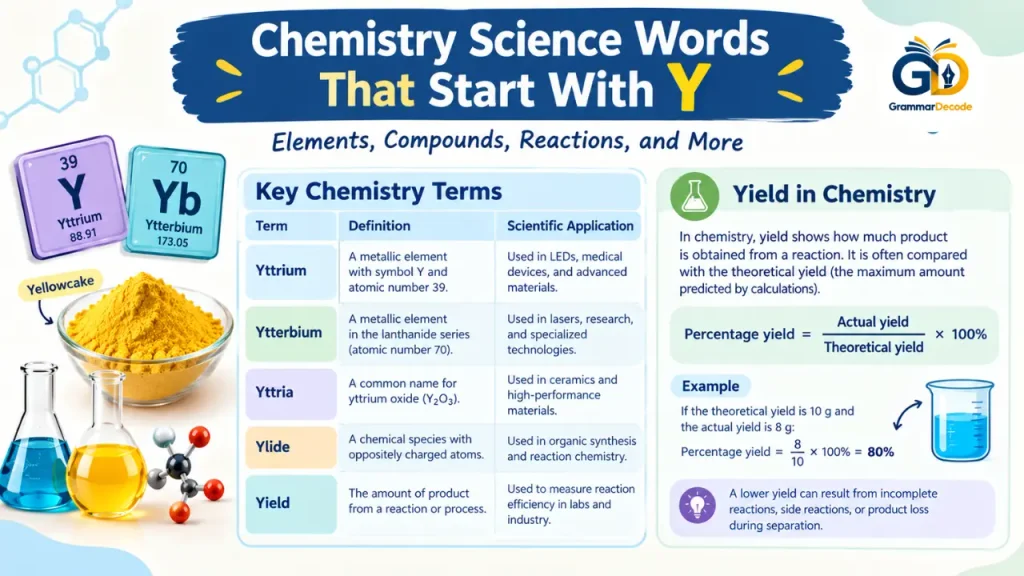
| Yttrium (Y) | A metallic chemical element with atomic number 39. | Used in specialized alloys, ceramics, phosphors, and other technological materials. |
| Ytterbium (Yb) | A metallic element in the lanthanide series, with atomic number 70. | Used in some lasers, research applications, and specialized technologies. |
| Yttria | A common name for yttrium oxide, with the formula Y₂O₃. | Used in ceramics and other advanced materials. |
| Yttrium oxide | A compound made from yttrium and oxygen. | Used in specialized ceramics, optical materials, and other applications. |
| Yttrium nitrate | A nitrate compound containing yttrium ions. | Used in chemical preparation and materials research. |
| Ytterbium chloride | A compound containing ytterbium and chloride. | Used in chemical research and preparation of other ytterbium compounds. |
| Ytterbium fluoride | A compound containing ytterbium and fluorine. | Relevant to specialized materials and chemical research. |
| Yttrium-containing material | A material formulated with yttrium or one of its compounds. | The exact purpose depends on the material’s composition and properties. |
Chemical Processes and Technical Terms
| Term | Simple meaning |
|---|---|
| Ylide | A chemical species with formally positive and negative charges on adjacent atoms, often discussed in organic chemistry. |
| Ylide chemistry | The study of ylides, their properties, and their reactions. |
| Ylide reaction | A reaction involving an ylide. The precise outcome depends on the type of ylide and the reaction conditions. |
| Yttrium compound | Any chemical compound containing yttrium. Its properties depend on the other elements and the compound’s structure. |
| Ytterbium compound | A chemical compound containing ytterbium. Different compounds can have very different chemical and physical properties. |
Yield in Chemistry
In chemistry, yield describes the amount of product obtained from a reaction. Scientists often compare the quantity actually collected with the quantity predicted by chemical calculations.
Three related terms are especially important:
| Term | Meaning |
|---|---|
| Theoretical yield | The maximum amount of product predicted by a calculation based on the balanced reaction and the available reactants. |
| Actual yield | The amount of product obtained in the experiment. |
| Percentage yield | The actual yield divided by the theoretical yield, multiplied by 100%. |
Physics Science Words That Start With Y
Physics terms beginning with Y include concepts related to material behavior, waves, motion, and measurements. Some also appear in engineering because engineers use physical principles to design and test structures and machines.
Young’s Modulus and Material Properties
| Term | Simple meaning |
|---|---|
| Young’s modulus | A measure of a solid material’s stiffness under elastic tension or compression. |
| Yield strength | The stress associated with the onset of permanent deformation under a specified test or convention. |
| Yield stress | A stress level associated with yielding; its precise definition depends on the material and testing method. |
| Yield point | A point on a material’s stress–strain curve associated with the start of yielding, when the material exhibits a distinguishable yield point. |
| Yield load | The applied load corresponding to yielding under the relevant test conditions. |
| Young modulus | An alternative spelling or shortened form of Young’s modulus. |
Young’s modulus and yield strength measure different properties. Young’s modulus describes stiffness in the elastic range, while yield strength describes resistance to the onset of permanent deformation. A material can be stiff without necessarily having a particularly high yield strength.
For example, when engineers compare materials for a beam, Young’s modulus helps them estimate how much the beam will deform under a load. Yield strength helps them assess when the material may begin to deform permanently.
Waves, Optics, and Other Physics Concepts
| Term | Simple meaning |
|---|---|
| Young’s double-slit experiment | An experiment in which light passing through two narrow openings produces an interference pattern under suitable conditions. |
| Young’s interference experiment | Another name for the double-slit experiment associated with Thomas Young. |
| Yaw | Rotation about a vertical axis defined relative to a chosen reference frame. |
| Yaw angle | The angle describing an object’s yaw orientation. |
| Yaw rate | The rate at which the yaw angle changes over time. |
| Yarkovsky effect | A small force on a rotating body caused by the uneven emission of thermal radiation; it can gradually alter the body’s orbit. |
Young’s double-slit experiment is important because the resulting bright and dark bands provide evidence of wave interference. The exact interpretation depends on the experimental setup, but the experiment is a classic demonstration in wave optics.
Yaw is also context-dependent. In aircraft, ships, vehicles, and robotics, it commonly describes rotation around a vertical axis, although the reference frame and sign convention depend on the application.
Yield and Yield Strength in Physics and Engineering
The word yield has different meanings in different scientific settings.
- In chemistry, it usually refers to the amount of product obtained from a reaction.
- In materials science, yielding refers to the onset of permanent deformation.
- In engineering, yield strength helps designers assess whether a material can withstand a specified stress without beginning to deform permanently.
A stress–strain graph can help show the distinction. Young’s modulus is related to the slope of the initial elastic region, while yield strength indicates the stress associated with the beginning of yielding according to the method used.
Read: 23 Another Word for Party With Meanings and Examples
Earth and Environmental Science Words That Start With Y
Earth and environmental science have fewer widely used Y terms than some other disciplines. It is better to explain established geological and resource-related terms accurately than to add ordinary phrases that only sound scientific.
Geology and Earth’s Surface
| Term | Simple meaning |
|---|---|
| Yardang | An elongated ridge or hill carved mainly by wind erosion, often in dry environments. |
| Yardang field | An area containing multiple yardangs shaped by wind erosion. |
| Yardang formation | The process through which wind abrasion and the removal of loose material shape a yardang. |
Yardangs often have a streamlined appearance when viewed from above. Their shapes develop through the combined effects of wind-driven particles and the removal of material from exposed surfaces.
Environmental and Agricultural Science
| Term | Simple meaning |
|---|---|
| Yellowcake | A concentrated uranium-bearing material produced during uranium processing. Despite its name, its appearance and composition can vary with the production process. |
| Yield | The amount of a crop, biological product, or resource produced under specified conditions. |
| Agricultural yield | The amount of a crop harvested from a given area or production system. |
| Crop yield | The quantity of a crop harvested, often measured per unit of land. |
| Yield per hectare | The amount of agricultural output produced from one hectare of land. |
The word yield is common in agricultural science, but phrases such as crop yield are ordinary technical combinations rather than necessarily unique, formally defined scientific concepts. Their usefulness comes from the specific quantity being measured.
Environmental and agricultural terminology should always be explained in context. For example, a yield measurement needs a defined crop, area, period, and unit to be meaningful.
Astronomy and Space Science Words That Start With Y
Astronomy includes terms for stars, astronomical effects, and research facilities. A few established examples begin with Y, but they do not all describe the same kind of astronomical object.
Stars and Stellar Classification
| Term | Simple meaning |
|---|---|
| Yellow dwarf | A traditional descriptive term for a yellowish main-sequence star, such as the Sun. |
| Yellow dwarf star | Another form of the term yellow dwarf, commonly associated with Sun-like stars. |
| Young stellar object | A star or forming star in an early stage of its development. |
| Young star | A star that is relatively early in its stellar evolution; the exact meaning depends on the context. |
| Young stellar population | A group of relatively young stars studied together in an astronomical region. |
The Sun is often described as a yellow dwarf, although astronomers classify stars more precisely using characteristics such as spectral type, temperature, and luminosity. NASA’s astronomy glossary describes yellow dwarfs as main-sequence stars that include the Sun.
A young stellar object is not a single formal age category that applies identically to every star. The term covers early evolutionary stages, and astronomers may use more specific classifications when discussing how a star is forming.
Other Verified Space Science Terms
| Term | Simple meaning |
|---|---|
| Yarkovsky effect | A small change in the motion of a rotating body caused by the uneven release of absorbed heat as thermal radiation. |
| Yerkes Observatory | An astronomical observatory in Williams Bay, Wisconsin, known for its historic research facilities and telescope. |
| Ylem | A historical term used in some early cosmological discussions for primordial matter or the material from which the universe was thought to develop. |
The Yarkovsky effect matters in planetary science because a small, gradual change in an asteroid’s motion can accumulate over long periods. Its strength and direction depend on factors such as the body’s size, rotation, surface properties, and thermal behavior.
Yerkes Observatory is different from the other entries in this section: it is a research institution, not a star, celestial object, or physical effect. Similarly, ylem is a historical scientific term rather than a standard label used for a specific modern astronomical object.
Medical and Health Science Words That Start With Y
Medical and health science use some Y terms from genetics and microbiology. Many overlap with biology, but they have particular relevance to human health, disease research, or laboratory work.
Medical and Biomedical Terminology
| Term | Simple meaning | Relevant field |
|---|---|---|
| Y chromosome | A human sex chromosome that carries genes involved in sex development and other functions. | Genetics and reproductive biology |
| Y-linked inheritance | A pattern of inheritance involving a gene on the Y chromosome. | Medical genetics |
| Yersiniosis | An infection caused by certain bacteria belonging to the genus Yersinia. | Infectious disease |
| Yersinia pestis | The bacterium that causes plague. | Microbiology and infectious disease |
| Yersinia enterocolitica | A bacterial species that can cause gastrointestinal illness. | Clinical microbiology |
| Yolk sac | An embryonic structure with roles in early development that vary among animals. | Developmental biology and embryology |
These terms describe different biological levels. A chromosome carries genetic information, an inheritance pattern describes how genetic traits are passed on, and a bacterial species identifies a microorganism. A disease or infection is not the same thing as the organism that causes it.
Microorganisms and Disease-Related Terms
| Term | Meaning |
|---|---|
| Yersinia | A genus of bacteria containing several species relevant to human and animal health. |
| Yersinia infection | An infection caused by bacteria of the genus Yersinia. The effects depend on the species and circumstances. |
| Yersiniosis | An illness caused by certain Yersinia bacteria, often involving the digestive system. |
| Yellow fever | A viral disease transmitted by infected mosquitoes in certain regions. |
Although Yersinia and yellow fever both appear in discussions of infectious disease, they are not directly equivalent terms. Yersinia is a bacterial genus, whereas yellow fever is caused by a virus. This distinction matters when learning microbiology and understanding how diseases are classified.
Technology and Applied Science Words With Y
Technology and applied science use terms related to materials, movement, coordinate systems, and measurements. Some of these terms are borrowed from physics or mathematics rather than belonging exclusively to technology.
Engineering and Materials Science
| Term | Simple meaning | Application |
|---|---|---|
| Young’s modulus | A measure of stiffness in the elastic range. | Comparing how much materials deform under a given stress. |
| Yield strength | The stress associated with the onset of permanent deformation under a defined test or convention. | Selecting materials for structures and mechanical components. |
| Yield stress | A stress level associated with yielding. | Evaluating the mechanical behavior of materials. |
| Yield load | The load corresponding to yielding under the relevant test conditions. | Assessing a component’s behavior under applied force. |
| Yaw | Rotation around a defined vertical axis. | Describing the orientation of vehicles, aircraft, ships, or robots. |
| Yaw angle | An angle representing yaw orientation. | Navigation, control systems, and motion analysis. |
| Yaw rate | The rate of change of yaw angle. | Vehicle stability and motion-control systems. |
In engineering, the exact meaning of a term depends on how the system or material is tested. For example, yield strength may be determined using a specified test method, including an offset method when a material does not show a sharp yield point.
Computing, Measurement, and Technical Notation
| Term | Simple meaning |
|---|---|
| Y-axis | The axis used to represent the y-coordinate in a graph or coordinate system. |
| Y-intercept | The point at which a graph intersects the y-axis, if it intersects it. |
| Y-coordinate | The coordinate that specifies a point’s position in the y-direction in a suitable coordinate system. |
| Yaw rate | A measure of rotational motion used in control systems and navigation. |
| Yield value | A value representing output from a process, calculation, or system; its precise meaning depends on the application. |
Not every term in this table is a computing-specific term. The Y-axis, Y-intercept, and Y-coordinate are mathematical concepts frequently used in programming, visualization, engineering, and data analysis. Their classification depends on the context in which they appear.
Words That Start With Y in Mathematical Science
Mathematics provides a small but useful set of Y-related terms. These are especially important in graphing, coordinate geometry, algebra, and the presentation of scientific data.
Coordinates, Axes, and Mathematical Notation
| Term | Simple meaning | Example or use |
|---|---|---|
| Y-axis | The axis that represents the y-direction in a standard two-dimensional coordinate graph. | The vertical axis in a conventional x-y graph. |
| Y-coordinate | The coordinate giving a point’s position along the y-direction. | In the point (3, 5), the y-coordinate is 5. |
| Y-intercept | The point where a graph crosses the y-axis, when such a crossing exists. | For \(y=2x+4\), the y-intercept is (0, 4). |
| Y-variable | A variable represented by the symbol \(y\). | In an equation such as \(y=3x+1\), \(y\) represents the dependent variable in the usual interpretation. |
| Y-function notation | A descriptive phrase for representing an output as \(y\); it is not a single universal formal term. | In \(y=f(x)\), \(y\) is the output associated with input \(x\). |
Mathematical Terms Used Across Science
Mathematical notation appears in scientific graphs, experiments, simulations, and engineering calculations. For example, a researcher may plot temperature against time, using one axis for time and the other for temperature. The choice of axes depends on the graph’s design and purpose.
A graph’s y-coordinate and y-intercept can help readers interpret trends, compare measurements, and understand equations. However, terms such as Y-axis and Y-coordinate are mathematical vocabulary used in science, not separate scientific discoveries.
Easy Science Words That Start With Y
Some Y words are easier to learn because they connect to familiar objects or common classroom concepts.
Simple Y Science Words With Everyday Examples
| Word | Simple meaning | Everyday connection |
|---|---|---|
| Yeast | A type of fungus. | Yeast helps dough rise when making bread. |
| Yolk | The nutrient-rich part of an egg. | An egg yolk is easy to observe when an egg is opened. |
| Y-axis | The vertical axis on a standard coordinate graph. | Students use it to read points on a graph. |
| Yttrium | A chemical element with symbol Y. | It appears in lessons about the periodic table and advanced materials. |
| Yield | The amount of product or output produced. | A science experiment may measure how much product a reaction creates. |
| Yaw | Rotation around a defined vertical axis. | It can describe the turning motion of a vehicle or aircraft. |
Scientific Words Students Should Learn First
For introductory study, begin with yeast, yolk, Y chromosome, Y-axis, and yttrium. These examples introduce different scientific categories without requiring advanced mathematical or chemical knowledge.
Once you understand the basic terms, move on to more technical concepts such as Young’s modulus, yield strength, and the Yarkovsky effect. Learning the scientific field and one real example for each term is usually more effective than memorizing a definition in isolation.
Advanced and Technical Science Words With Y
Some scientific words beginning with Y require knowledge of a particular subject. The following terms are useful examples of advanced vocabulary in chemistry, physics, genetics, and astronomy.
Advanced Concepts and Specialized Terminology
| Term | Scientific field | Simple explanation |
|---|---|---|
| Ylide | Organic chemistry | A chemical species with formally opposite charges on adjacent atoms. |
| Y-linked inheritance | Genetics | Inheritance involving a gene located on the Y chromosome. |
| Yttria | Materials science | A common name for yttrium oxide, used in specialized materials. |
| Young’s modulus | Materials science | A property describing stiffness in the elastic range. |
| Yield strength | Mechanical engineering | A measure of stress associated with the onset of permanent deformation. |
| Yield stress | Materials science | A stress level associated with the transition toward yielding. |
| Young’s double-slit experiment | Optics | An experiment demonstrating interference between waves passing through two openings. |
| Yarkovsky effect | Planetary science | A small force caused by uneven thermal radiation that can alter an object’s motion. |
| Young stellar object | Astronomy | A star in an early stage of formation or evolution. |
| Yersinia pestis | Microbiology | The bacterial species responsible for plague. |
| Yersinia enterocolitica | Microbiology | A bacterial species that can cause intestinal illness. |
| Y-coordinate | Mathematics | The coordinate representing a point’s position in the y-direction. |
Some terms are closely related but have different meanings. For instance, Young’s modulus measures stiffness, whereas yield strength relates to the beginning of permanent deformation. A material can have a high value for one property without having an equally high value for the other.
How to Understand Technical Scientific Definitions
When you encounter an unfamiliar scientific term, use these steps:
- Identify the field. Determine whether the term belongs to biology, chemistry, physics, mathematics, or another subject.
- Learn the core definition. Find out what the term identifies or measures.
- Look for an example. A practical application can make an abstract concept easier to understand.
- Compare related terms. Check whether a similar word describes a different process, property, or object.
- Verify specialized meanings. Use a reliable scientific glossary, textbook, university resource, or reference organization.
This approach is especially useful for words such as yield, which can describe product formation in chemistry, agricultural output, or the onset of material deformation, depending on the context.
Read: LMY Meaning Explained: What It Stands For and How to Use It
Fun Facts About Science Words That Start With Y
- Yttrium has the symbol Y. It is a chemical element with atomic number 39 and has applications in specialized alloys and technological materials.
- Ytterbium has a different chemical symbol. Its symbol is Yb, and its atomic number is 70. Both yttrium and ytterbium are metals, but they are distinct elements with different properties.
- Yeast connects biology with food science. Certain yeasts ferment sugars, producing carbon dioxide that helps bread dough rise.
- The Y chromosome is important in genetics. It carries genes involved in sex development and is studied to understand particular patterns of inheritance.
- Young’s modulus helps engineers compare materials. It describes elastic stiffness, which is important when estimating how much a component will deform under a load.
- The Yarkovsky effect can influence asteroid motion. A small change in motion can become significant over long periods, making the effect relevant to planetary science.
Frequently Asked Questions About Science Words That Start With Y
Which Y Science Words Are Used in Astronomy?
Examples include yellow dwarf, young stellar object, Yarkovsky effect, and Yerkes Observatory. A yellow dwarf is a descriptive term for certain main-sequence stars, a young stellar object is in an early stage of development, the Yarkovsky effect influences the motion of small bodies, and Yerkes Observatory is an astronomical research facility.
Can Yield Be Used in Both Chemistry and Physics?
Yes. In chemistry, yield generally refers to the amount of product obtained from a reaction. In materials science and mechanics, yielding describes the onset of permanent deformation. Yield strength is a specific material property, not another name for chemical reaction yield.
What Are Some Biology Words That Start With Y?
Examples include yeast, yolk, Y chromosome, Y-linked inheritance, yolk sac, and Yersinia. These terms describe different things: an organism, a biological structure, a chromosome, a genetic pattern, an embryonic structure, and a bacterial genus.
Are There Many Scientific Words That Start With Y?
There are fewer widely used scientific terms beginning with Y than there are for some other letters. The available vocabulary depends on the field and whether specialized compounds, technical expressions, and mathematical notation are included. A numerical claim such as “200+” should only be used when the final glossary contains at least 201 distinct, relevant, verified entries.
Conclusion
Science words beginning with Y cover a range of subjects, from biology and chemistry to physics, astronomy, and mathematics. Learning their meanings in context helps students understand scientific explanations and use technical vocabulary more accurately.
When building a glossary, prioritize verified terms, clear definitions, and practical examples rather than adding questionable expressions simply to increase the word count.