

Well Deserve or Well Deserved: Which One Is Grammatically Correct?
It’s surprising how a simple phrase can lead to widespread confusion, particularly with “well deserve” and “well deserved.” Grasping the correct usage of these expressions is important for anyone looking to enhance their linguistic precision.
In this article, we’ll explore the nuances of grammar, verb forms, and past participles, making it easier for you to avoid common pitfalls. Expect straightforward examples and clear explanations that will empower you with the knowledge needed for flawless communication.
Understanding the Core Confusion Of Well Deserve or Well Deserved
The core confusion between well deserve and well deserved often stems from the differing roles of verb tense and sentence structure. “Well deserved” serves as an adjective, indicating that something has been earned in the past, as in “the reward was well deserved.”
Here, “deserved” conveys a sense of completion, an acknowledgment of merit based on previous actions. Conversely, “well deserve” misplaces the verb tense, as “deserve” remains an active verb that implies ongoing action, typically requiring a subject to convey its meaning, like in, “They well deserve recognition,” though this structure can sound awkward to many.
The Correct Phrase: Well Deserved
The phrase well deserved stands out for its distinctive grammatical structure, specifically the use of the past participle deserved. This construction implies that the individual has not only earned something but has done so through commendable actions or efforts over time.
When we say someone is well deserved of praise, reward, or rest, we are acknowledging a level of merit that rise above mere entitlement, suggesting a moral or ethical alignment to the accolades received.
The addition of well amplifies the sentiment, underscoring the depth of recognition due. It transforms the phrase from a straightforward declaration to a heartfelt insistence of someone’s efforts.
Well Deserved: Meaning and Usage
The phrase well deserved signifies recognition or reward for an achievement that has been earned through hard work, skill, or ethical behavior. It functions as an adjective phrase, often placed before a noun to emphasize that the recognition or reward is genuinely earned.
For instance, one might say someone received a well-deserved promotion, highlighting that their effort and dedication justly led to this advancement in their career.
In usage, well deserved goes beyond various contexts, making it versatile in professional, academic, and casual settings. In the workplace, it acknowledges employees’ contributions, fostering a positive and motivating culture.
In academia, it may be employed to describe a student’s success after diligent study or research, reinforcing the connection between effort and outcome.
Even in everyday conversation, this phrase resonates, whether celebrating a friend’s hard-earned achievements or praising acts of kindness.
Examples of Using Well Deserved in A Sentence
- She finally received a well deserved promotion after years of hard work.
- The team enjoyed a well-deserved victory at the end of the season.
- Take a well deserved break and recharge your energy.
- His success is well deserved, given his dedication.
- The actor earned well-deserved praise for the powerful performance.
- After months of training, her medal was well deserved.
- They celebrated their well-deserved achievement together.
- The teacher gained well-deserved respect from her students.
- His reputation as a leader is well deserved.
- The vacation felt truly well deserved after a stressful year.
Is Well Deserve Ever Correct?
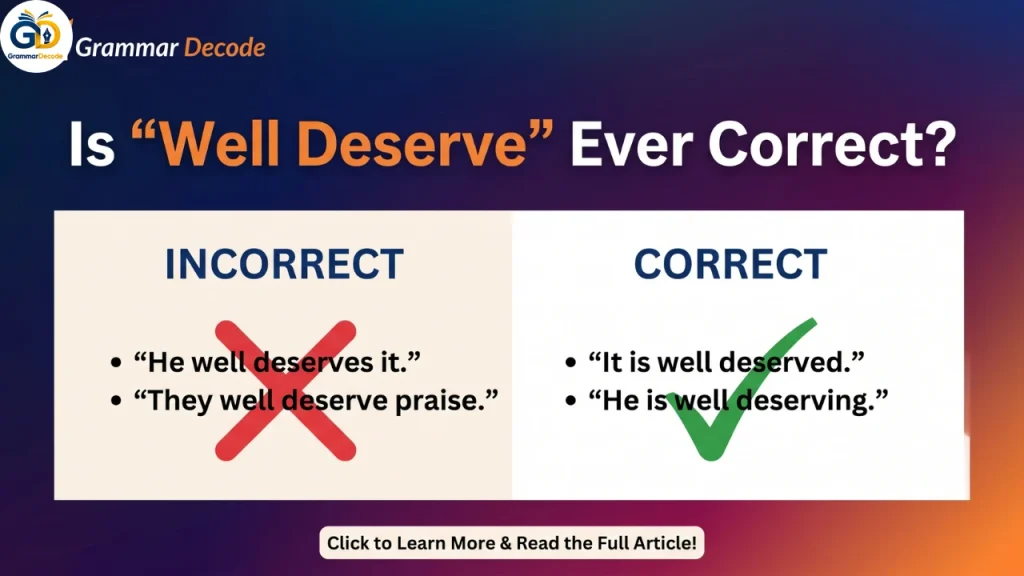
The phrase well deserve can indeed be grammatically correct, depending on its construction in a sentence. Primarily, it serves as a present-tense verb phrase where the subject, such as I, you, we, or they, collaborates with well to emphasize an deserved action.
For instance, one might say, “You well deserve the recognition for your hard work.” This structure, although correct, often sounds formal or somewhat archaic in modern English, which might be why many writers and speakers prefer more straightforward alternatives.
In casual contexts, expressions like “you deserve it” or “well-deserved” are favored for their accessibility and clarity. “You deserve it” directly addresses the listener and communicates a strong statement of merit, while “well-deserved” functions as an adjective, seamlessly fitting into everyday conversation.
Well Deserved as an Adjective Phrase
The adjective phrase well-deserved serves as a powerful term of nouns, highlighting the notion that something has been earned or merited. Typically, it modifies nouns such as praise, awards, or recognition, signifying that these accolades are not merely given but truly warranted.
For instance, when one receives “well-deserved praise,” it conveys a sense of fairness, suggesting that the recognition is based on outstanding effort or achievements rather than personal opinion.
This is why phrases like well-deserved praise, well-deserved award, and well-deserved recognition are grammatically correct.
Well Deserved vs Well Deserve in Spoken English
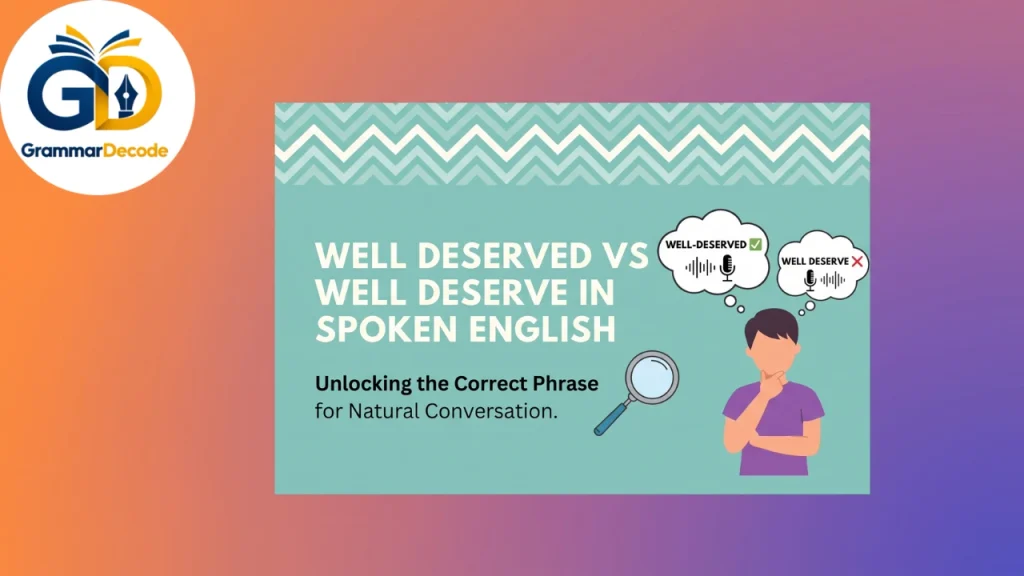
In spoken English, the distinction between well deserved and well deserve can often be overlooked, yet it plays a significant role in conveying meaning. Well deserved is the grammatically correct form used as an adjective to describe something that has been duly earned.
For example, when someone receives an award, you might say, “That recognition is well deserved.” This expression acknowledges the effort and merit behind the achievement, making it a common phrase in everyday conversation.
On the flip side, well deserve is not standard in English. However, you might hear it used informally or incorrectly in casual speech, especially among those who bend grammar for a more relaxed tone.
For instance, someone might say, “You really well deserve that honor,” but this is considered incorrect. Using well deserved correctly promotes grammatical accuracy while making expressions of praise and recognition more meaningful, emphasizing the value of clearly acknowledging achievements that have truly been earned.
Why Native Speakers Prefer Well Deserved
Native speakers prefer well-deserved because it follows natural English grammar and fluency. As an adjective, it clearly expresses fairness and merit when describing nouns such as praise, success, or rest.
In contrast, well deserve sounds incomplete because “deserve” is a verb that typically requires a subject. Using well-deserved therefore makes communication clearer, more natural, and more meaningful.
How to Remember the Difference Easily
To remember the difference, focus on how the phrase works in a sentence. Well-deserved is an adjective used to describe something that has been earned, such as praise, a reward, or a promotion.
For example: She received a well-deserved promotion.
Well deserve is incorrect when used before a noun because deserve is a verb. A simple trick is to replace well-deserved with earned. If the sentence still makes sense, the adjective form is likely correct. This easy method can help you avoid common mistakes.
Common Mistakes To Avoid
A common mistake is using well deserve instead of well-deserved when describing a noun such as praise, a reward, or recognition. Well-deserved is the correct adjective form, while deserve is a verb and must be used with a proper subject and sentence structure.
Writers should also avoid relying on informal internet usage, which may contain incorrect grammar. By considering the sentence structure and context, you can use well-deserved correctly and communicate more clearly.
Real-Life Conversations

WhatsApp Chat
Ayesha: Just got my test results — I passed with distinction!
Ali: Woah, Ayesha! That’s well deserved! You worked so hard this semester.
Instagram DMs
User1: Your sketches are amazing
User2: Thanks! Means a lot!
User1: That feature in the art magazine? Well deserved
TikTok Comments
Commenter A: Bro finally hit 100K subs
Commenter B: Well deserved — your videos are fire
These conversations show how natural and supportive the phrase feels in daily interactions.
Usage in Different Contexts
Social Media
Used to celebrate milestones:
- Celebrating birthdays, achievements, promotions
- Commenting on before/after transformations
Friends & Relationships
Used to show emotional support:
- After someone’s tough week
- After someone overcomes a struggle
Work or Professional Settings
Used in recognition:
- Performance appraisal
- Team accomplishments
Casual vs Serious Tone
- Casual: “Well deserved, man!”
- Serious: “Your recognition was well deserved given your contributions.”
The meaning stays the same, but tone changes based on formality.
More Grammar About Visit: GrammarDecode.com
Conclusion
The phrase well deserved is the appropriate and widely accepted expression for conveying earned achievements, rewards, praise, and rest. As an adjectival phrase, it aptly describes the merit associated with accomplishments, emphasizing the recognition that individuals rightfully earn.
Its frequent usage in both spoken and written language underscores its natural fit in contexts of commendation and recognition. While there may be rare instances where well deserve could be used, particularly in a present-tense construction, such occurrences are not the norm and can lead to confusion.
Therefore, embracing well deserved in your communication is crucial for clarity and correctness; let’s ensure we honor achievements with the language they merit.
FAQs
Is it Correct to Say Well Deserve in Sentence?
Only in rare cases as a present-tense verb with a subject, e.g., They well deserve the reward. Otherwise, it’s usually incorrect.
What does Well Deserved Mean in Simple Words?
It means someone earned something fairly because of effort or qualities.
How is it Different from Deserved?
Well deserved sounds stronger or more sincere than just deserved.