
Synonym for Opportunity: 20 Other Ways to Say Opportunity (With Examples)
Finding the right synonym for opportunity can help you express your ideas more clearly and make your writing sound natural and engaging. Whether you’re looking for another way to say opportunity in everyday conversations, professional emails, or formal writing, choosing the right words can make a big difference.
In this article, we’ve shared 20 other ways to say opportunity, along with their meanings and practical examples. You’ll also discover synonyms of opportunities and better alternatives for phrases like “exciting opportunity” and “better opportunity” to help you choose the perfect expression for any situation.
What Does Opportunity Mean?
An opportunity is a situation that gives someone a chance to do something useful, achieve a goal, or improve their circumstances. It might be a new job, a scholarship, a business idea, or even a moment to learn something valuable. Opportunities can be planned or unexpected, and some are more promising than others.
For example, getting invited to a job interview is an opportunity to introduce yourself to an employer. Similarly, joining a training program provides an opportunity to develop new skills. The meaning stays almost the same in both situations, but the words you choose to describe these opportunities can change depending on the context.
Read Also: Reply of Take Care of Yourself: Best Responses for Every Situation
20 Different Ways to Say Opportunity: Another Word for Opportunity
Looking for another way to say opportunity without changing the meaning of your sentence? The following words and phrases are useful alternatives, although each carries a slightly different meaning. Some describe a chance to succeed, while others highlight a favorable situation, a possible opening, or the right time to act.
| Synonym | Example Sentence |
|---|---|
| Chance | I finally got a chance to visit my dream university. |
| Opening | There’s an opening in the marketing department. |
| Occasion | The meeting provided an occasion to discuss our plans. |
| Possibility | We should explore the possibility of working together. |
| Break | Her first acting role was the big break she needed. |
| Shot | Give yourself a shot at achieving something great. |
| Window of Opportunity | We have a small window of opportunity to apply. |
| Moment | This is your moment to make a difference. |
| Advantage | His experience gave him an advantage over other candidates. |
| Privilege | It’s a privilege to learn from such an experienced teacher. |
| Offer | She received an offer to join the company. |
| Option | Working remotely is another option worth considering. |
| Open Door | The internship could be an open door to a successful career. |
| Chance of a Lifetime | Traveling abroad was a chance of a lifetime for him. |
| Prospect | The prospect of starting a new business excited her. |
| Occasion to Act | The announcement gave us an occasion to act. |
| Favorable Time | Spring is a favorable time to launch the project. |
| Benefit | One benefit of the program is access to expert guidance. |
| Opportunity Knocks | When opportunity knocks, make sure you’re prepared. |
| Golden Chance | The competition is a golden chance to showcase your talent. |
Not every expression in this table is a direct replacement for opportunity. Words like benefit, offer, and advantage have more specific meanings, while opportunity knocks is an idiom. Understanding those differences will help you select the right word instead of replacing one term with another simply because they sound similar.
1. Chance
Chance is one of the most common and natural alternatives to opportunity. It describes a situation where someone has the possibility of doing something or achieving a particular result. You’ll hear this word in everyday conversations, especially when people talk about their goals, experiences, and personal decisions.
Unlike opportunity, which can sometimes sound formal, chance feels friendly and straightforward. You might ask someone for a chance to explain themselves or talk about getting a chance to learn something new. It’s especially useful when the outcome isn’t guaranteed, but trying is still worthwhile.
Examples:
- I got a chance to meet my favorite author.
- Everyone deserves a chance to prove themselves.
- She didn’t want to miss the chance to study abroad.
- Give me one more chance to explain what happened.
2. Opening
An opening refers to an available position, a suitable moment, or a situation that makes something possible. It’s particularly common in professional settings, such as job searches, business discussions, and career planning. When a company advertises an opening, it usually means there’s a position available for someone to fill.
You can also use opening when talking about an unexpected chance to make progress. For example, a growing market may create an opening for a new business. The word works best when there is a clear space or possibility for someone to take action.
Examples:
- There’s a job opening at the company where my sister works.
- He noticed an opening in the market for affordable clothing.
- The conversation gave me an opening to share my ideas.
- We have an opening for a new graphic designer.
3. Occasion
Occasion usually describes a particular event or time when something happens. Although it isn’t always a direct synonym for opportunity, it can express a suitable moment to take action, speak, celebrate, or accomplish something important. The word often appears in formal writing and polite conversations.
For example, you might say that a meeting provided an occasion to discuss future plans. Here, occasion suggests that the event created a suitable chance for discussion. It’s a useful alternative when the opportunity is connected to a specific event or moment.
Examples:
- The family dinner was a wonderful occasion to reconnect.
- The conference provided an occasion to meet industry experts.
- This is a good occasion to thank everyone for their support.
- She used the occasion to announce her new project.
4. Possibility
Possibility refers to something that could happen, even though the result isn’t certain. It’s an excellent alternative when you’re discussing future plans, potential outcomes, or situations that haven’t become definite opportunities yet. The word encourages people to think about what might happen rather than what is already available.
Imagine you’re considering moving to another city for work. You could describe the move as a possibility because you haven’t made a final decision. In comparison, a confirmed job interview would be a more concrete opportunity. This difference makes possibility particularly useful in planning and decision-making.
Examples:
- There’s a possibility that I’ll get promoted next month.
- We discussed the possibility of opening another store.
- She was excited about the possibility of studying overseas.
- Don’t ignore the possibility of finding something better.
5. Break
Break is an informal word used to describe an important opportunity, especially one that helps someone become successful. It’s commonly associated with careers, entertainment, sports, and situations where someone finally gets recognized after working hard or waiting patiently for something to happen.
You’ve probably heard someone talk about getting their big break. This expression means they received an important chance that helped them move forward. Unlike an ordinary opportunity, a break often feels special because it can lead to significant progress in someone’s life or career.
Examples:
- Her first television appearance was a big break in her career.
- He spent years waiting for his big break in music.
- That internship gave me the break I needed to enter the industry.
- Every young athlete hopes for a big break someday.
6. Shot
Shot is a casual alternative to opportunity that usually means a chance or attempt to achieve something. It’s particularly popular in spoken English and informal conversations. People often use expressions like give it a shot or take your shot when encouraging someone to try something new.
The word adds a sense of action and determination. For example, if your friend is nervous about applying for a competitive job, you might tell them to give it a shot. You’re encouraging them to try, even though there’s no guarantee they’ll succeed.
Examples:
- You should give that new business idea a shot.
- This might be your last shot at winning the competition.
- She finally got a shot at her dream job.
- Don’t be afraid to take a shot at something difficult.
7. Window of Opportunity
A window of opportunity describes a limited period when the conditions are right for doing something. Unlike a general opportunity, this expression emphasizes timing. It suggests that the chance may disappear if someone waits too long or fails to act at the right moment.
You’ll often find this phrase in business, education, politics, and everyday decision-making. For example, an application deadline may create a short window of opportunity for students. The phrase works especially well when you want to explain why taking action quickly is important.
Examples:
- There’s a small window of opportunity to register for the course.
- We need to act before the window of opportunity closes.
- The company has a window of opportunity to enter the market.
- She used the brief window of opportunity to submit her application.
8. Moment
Moment refers to a particular point in time, but it can also suggest an important chance to act or make a difference. People often use it when talking about personal achievements, emotional experiences, or situations that require immediate attention.
For example, saying “This is your moment” encourages someone to take advantage of an important opportunity. The expression feels more personal and inspiring than simply saying “You have an opportunity.” However, moment works best when the timing or significance of the situation matters.
Examples:
- This is your moment to show everyone what you can do.
- She waited for the right moment to share her opinion.
- He knew the moment had arrived to make a decision.
- Don’t let this important moment pass without taking action.
9. Advantage
Advantage describes something that puts a person in a better position to succeed. It’s related to opportunity because having an advantage can improve your chances of achieving a goal. However, the two words aren’t always interchangeable, since an advantage is a favorable condition rather than the chance itself.
For example, speaking several languages can give someone an advantage when applying for international jobs. In this situation, their language skills help them compete more effectively. Use advantage when you want to highlight what makes a particular situation more favorable for someone.
Examples:
- Her communication skills gave her an advantage during the interview.
- Studying early can give you an advantage in your exams.
- The company gained an advantage by introducing new technology.
- Having previous experience is a major advantage in this field.
10. Privilege
Privilege refers to a special benefit, right, or chance available to a particular person or group. It often carries a sense of appreciation or exclusivity, making it useful when describing an opportunity that someone feels fortunate to receive.
For instance, saying “It’s a privilege to work with you” expresses respect and gratitude. The sentence sounds warmer and more appreciative than simply describing the experience as an opportunity. However, privilege can also refer to unequal advantages in society, so its meaning depends on the context.
Explore: PTSO Meaning Slang: What It Really Means in 2026
Examples:
- It’s a privilege to learn from such an experienced professor.
- She considered it a privilege to represent her university.
- Working with talented professionals is a real privilege.
- He felt it was a privilege to receive the scholarship.
11. Offer
Offer refers to something presented to someone for acceptance or rejection. It’s commonly used when discussing jobs, business deals, services, and professional opportunities. An offer is usually more specific than an opportunity because it involves a proposal that someone can choose to accept.
For example, receiving a job offer means a company has invited you to work for them under certain conditions. You might have several career opportunities, but only one confirmed job offer. Understanding this distinction helps you communicate more clearly in professional conversations.
Examples:
- She received an excellent job offer from an international company.
- I couldn’t refuse the offer to join their research team.
- The university made him an offer to study there.
- He accepted the offer after discussing the salary.
12. Option
Option describes a choice or alternative available to someone. It’s closely related to opportunity because having different options often means having several possible paths to follow. However, an option emphasizes the freedom to choose, while an opportunity focuses on the chance to achieve something.
Imagine you’re deciding whether to study abroad or continue your education locally. Both are options, and each may offer different opportunities for your future. The word is particularly useful when discussing decisions, career choices, education, and personal plans.
Examples:
- Working from home is another option worth considering.
- She explored every option before choosing a university.
- You always have the option to learn something new.
- Starting a small business could be a good option for him.
13. Open Door
Open door is a figurative expression that describes a situation that makes future progress or success possible. It’s commonly used when explaining how one experience can lead to several new opportunities. The expression creates a positive image of moving forward and discovering new possibilities.
For example, completing an internship might open doors to better career opportunities. The internship itself isn’t necessarily the final goal, but it helps you move closer to achieving something bigger. This expression sounds natural in motivational writing, professional conversations, and discussions about personal growth.
Examples:
- Learning programming can open doors to exciting career paths.
- That scholarship opened the door to higher education.
- Networking with professionals can open doors to future opportunities.
- Her first successful project opened many doors in the industry.
14. Chance of a Lifetime
Chance of a lifetime describes an extremely rare or valuable opportunity that someone might never experience again. People use this phrase when talking about unforgettable experiences, major achievements, or important decisions that could significantly change their lives.
Unlike an ordinary opportunity, a chance of a lifetime carries a stronger emotional meaning. It suggests that the situation is extraordinary and deserves serious attention. You might use it when describing a dream job, an international scholarship, or an invitation to participate in something truly special.
Examples:
- Traveling around the world was a chance of a lifetime.
- She received a chance of a lifetime to study at her dream university.
- Don’t miss this chance of a lifetime to meet your favorite artist.
- Representing his country was a chance of a lifetime for the young athlete.
15. Prospect
Prospect refers to the possibility of something positive happening in the future. It’s commonly used in professional, financial, and educational contexts. Unlike opportunity, which often describes a chance that’s already available, prospect usually focuses on something that may develop later.
For example, a student might have excellent career prospects after completing a degree in computer science. This doesn’t mean a job is guaranteed, but it suggests that future employment opportunities look promising. Prospect is especially useful when discussing long-term plans and potential success.
Examples:
- The prospect of working abroad made her excited.
- His career prospects improved after completing the training.
- The company sees strong prospects for growth next year.
- She was encouraged by the prospect of getting a promotion.
16. Occasion to Act
Occasion to act describes a suitable moment or situation in which someone can take meaningful action. Although less common than expressions such as chance to act or right moment, it can be useful in formal writing when a particular event creates an opportunity.
For example, a community meeting might provide an occasion to act on local problems. The expression places importance on recognizing the situation and responding appropriately. In everyday English, “chance to act” will usually sound more natural, but “occasion to act” can work in formal contexts.
Examples:
- The meeting gave us an occasion to act on the team’s concerns.
- The announcement provided an occasion to act before the deadline.
- The conference offered an occasion to act on our shared goals.
- The new policy created an occasion to act on important issues.
17. Favorable Time
Favorable time means a period when circumstances are suitable for doing something successfully. It’s a useful alternative when the main idea behind an opportunity involves timing, preparation, or external conditions.
For instance, a business owner might wait for a favorable time to introduce a new product. This suggests they’re considering customer demand, market conditions, and available resources. Although favorable time isn’t a direct synonym for opportunity, it works well when describing situations where the timing increases the chances of success.
Examples:
- This is a favorable time to start saving for the future.
- The company waited for a favorable time to expand.
- Summer is a favorable time for many outdoor activities.
- She believed it was a favorable time to launch her business.
18. Benefit
Benefit describes a positive result, advantage, or helpful feature that someone receives from an action or situation. It’s connected to opportunity because opportunities often provide valuable benefits. However, benefit focuses on what someone gains rather than the chance itself.
For example, attending a professional workshop is an opportunity to learn, while gaining practical experience is one of its benefits. This difference matters when writing about education, employment, or personal development. Use benefit when you want to explain why a particular opportunity is valuable.
Examples:
- One benefit of studying abroad is experiencing a new culture.
- The training program offers several benefits to employees.
- Learning a second language has many professional benefits.
- She enjoyed the benefits of working with an experienced mentor.
19. Opportunity Knocks
Opportunity knocks is a popular English idiom suggesting that a valuable chance has appeared and shouldn’t be ignored. People often use it to encourage others to recognize opportunities and make decisions before those chances disappear.
Unlike the other alternatives, opportunity knocks is a complete expression rather than a replacement word. It works particularly well in motivational conversations, speeches, and informal writing. The phrase reminds us that sometimes success depends on being prepared to act when the right situation appears.
Examples:
- When opportunity knocks, don’t be afraid to answer.
- Opportunity knocked when she received an unexpected scholarship offer.
- He believes that opportunity knocks when you least expect it.
- When opportunity knocks, preparation can make all the difference.
20. Golden Chance
Golden chance describes a particularly valuable opportunity that could lead to an important achievement. It’s similar to golden opportunity, an expression commonly used in English to emphasize how promising or special a particular situation is.
For example, a student receiving a fully funded scholarship might describe it as a golden chance to pursue higher education. The phrase is especially useful when you want to express excitement, appreciation, or the importance of making the most of a rare opportunity.
Examples:
- This competition is a golden chance to demonstrate your creativity.
- She received a golden chance to work with an international company.
- Don’t waste this golden chance to improve your skills.
- The internship gave him a golden chance to enter his chosen profession.
Explore: 20 Other Words for EFFECTIVE | Effective Synonyms (Examples)
Synonyms of Opportunities: Words You Can Use Instead
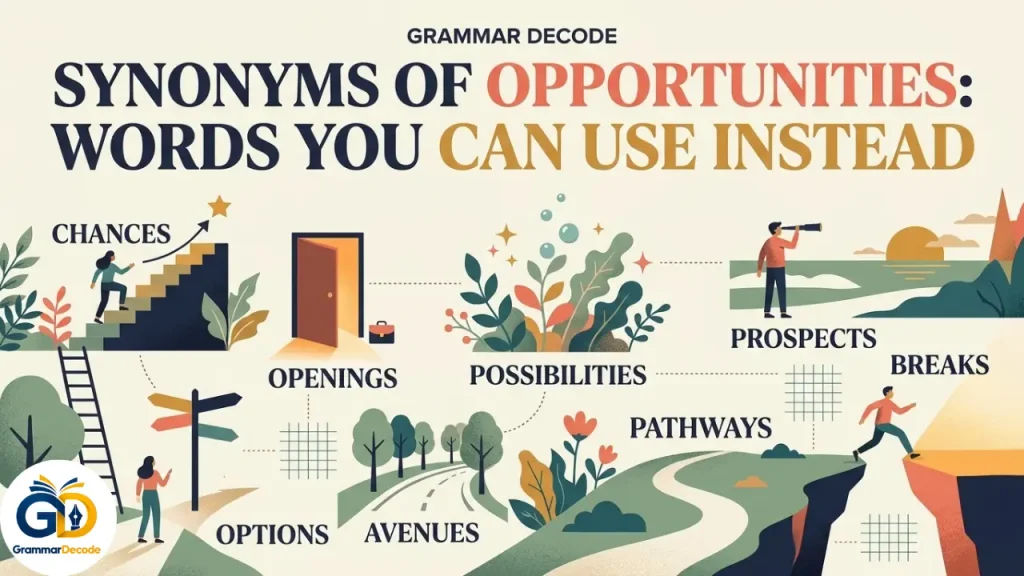
When writing about multiple chances or possibilities, you may need synonyms of opportunities rather than alternatives to the singular word. The right choice depends on whether you’re describing career openings, future possibilities, personal advantages, or available options.
Some of the most natural plural alternatives include chances, openings, possibilities, prospects, and options. However, they don’t always mean exactly the same thing. Choosing the most suitable word helps your writing sound clearer, particularly when discussing employment, education, business, or personal development.
| Synonyms of Opportunities | Best Used For |
|---|---|
| Chances | Everyday situations and personal goals |
| Openings | Available jobs or positions |
| Possibilities | Potential future outcomes |
| Prospects | Future career or business success |
| Options | Available choices |
| Avenues | Different ways to achieve something |
| Breaks | Important chances for career success |
| Pathways | Routes toward professional or personal progress |
| Possibilities for Growth | Personal development or business expansion |
| Career Openings | Available employment positions |
For example, instead of writing, “The company provides many opportunities for graduates,” you could say, “The company offers several career openings for graduates.” Both sentences communicate a similar idea, but the second is more specific about the opportunities being offered.
Another Word for Better Opportunity
Sometimes, an ordinary opportunity isn’t enough to describe what you’re trying to say. You might be comparing two jobs, discussing career growth, or explaining why you’re searching for something more rewarding. In these situations, another word for better opportunity can help you express your thoughts more professionally.
Expressions such as more promising prospect, greater chance, improved career prospects, and more rewarding position can replace better opportunity depending on your meaning. The important thing is to choose language that explains what makes the new situation better, whether that’s higher pay, greater responsibility, valuable experience, or personal development.
| Alternative Phrase | Example |
|---|---|
| More Promising Prospect | I’m considering a more promising prospect in the technology industry. |
| Greater Chance | This program gives students a greater chance of finding employment. |
| Improved Career Prospects | The certification could lead to improved career prospects. |
| More Rewarding Position | She’s looking for a more rewarding position with greater responsibilities. |
| Better Career Path | He decided to pursue a better career path. |
| Greater Potential | This role offers greater potential for professional growth. |
| More Favorable Option | The second proposal seems like a more favorable option. |
| Stronger Career Prospects | The new qualification gives graduates stronger career prospects. |
When discussing jobs, it’s often better to be specific about what you’re looking for. For example, “I’m seeking a role with more opportunities for professional development” sounds clearer than repeatedly saying, “I’m looking for a better opportunity.” The first sentence explains what matters most to you.
Exciting Opportunity Synonym: Better Phrases for Professional Writing
An exciting opportunity is a chance that creates enthusiasm because it offers something interesting, valuable, or rewarding. People frequently use this expression in job applications, professional emails, and LinkedIn posts. However, repeating it too often can make your writing sound predictable.
If you’re searching for an exciting opportunity synonym, think about what makes the situation exciting. Is it the chance to learn something new, work on an important project, or advance your career? Choosing an alternative that reflects the specific benefit will make your message more engaging and meaningful.
Here are some natural alternatives:
| Alternative Phrase | Example Sentence |
|---|---|
| Thrilling Prospect | The prospect of joining the research team is truly thrilling. |
| Promising Opportunity | This is a promising opportunity to develop my leadership skills. |
| Remarkable Chance | She received a remarkable chance to perform internationally. |
| Incredible Opportunity | Working with the organization would be an incredible opportunity. |
| Rewarding Experience | Teaching young students can be a rewarding experience. |
| Valuable Opportunity | The internship provides a valuable opportunity to gain experience. |
| Unique Chance | This program offers a unique chance to learn from industry experts. |
| Fantastic Opening | There’s a fantastic opening for a creative designer. |
| Golden Opportunity | The scholarship is a golden opportunity to continue my education. |
| Career-Defining Opportunity | Leading this project could be a career-defining opportunity. |
The best choice depends on your audience. In a professional email, valuable opportunity or promising opportunity usually sounds appropriate. In a casual conversation, amazing chance or fantastic opportunity may feel more natural and enthusiastic.
Another Way to Say Opportunity in Professional Emails
Professional emails often require polite and precise language. If you’re applying for a job, requesting a meeting, or thanking someone for their support, repeating opportunity in every sentence can make your message feel less polished.
You can use expressions such as chance to contribute, possibility of collaboration, career opening, or prospect of working together. These alternatives help you communicate professionally without using unnecessarily complicated language. The goal is to sound respectful and confident while keeping your message easy to understand.
Examples:
– Original: Thank you for giving me this opportunity.
Alternative: Thank you for giving me the chance to contribute to your team.
– Original: I’m excited about this opportunity.
Alternative: I’m enthusiastic about the prospect of working with your organization.
– Original: I appreciate the opportunity to meet you.
Alternative: I appreciate the chance to connect and learn more about your work.
– Original: I’m looking for new opportunities.
Alternative: I’m exploring new career openings that match my experience.
Another Way to Say Opportunity in Everyday Conversations
In everyday English, simple words usually work better than formal expressions. When you’re talking to friends, classmates, or family members, alternatives such as chance, shot, break, and option sound more comfortable and natural.
For example, instead of saying, “I received an opportunity to participate in the competition,” you could say, “I got a chance to take part in the competition.” Both sentences are correct, but the second feels more relaxed. Learning these differences can make your conversations smoother and more enjoyable.
Examples:
- I finally got my chance to travel abroad.
- You should give that idea a shot.
- She got a lucky break after months of searching.
- We have another option if this plan doesn’t work.
- This could be your moment to shine.
How to Choose the Right Synonym for Opportunity
Choosing the correct synonym isn’t just about finding a word with a similar meaning. You also need to consider the situation, your audience, and the message you want to communicate. A word that sounds perfect in a conversation with friends might not be appropriate for a formal business email.
For example, shot is a good choice when encouraging someone informally, while prospect sounds more suitable when discussing future career possibilities. Similarly, opening works naturally for available jobs, whereas window of opportunity highlights a situation where timing is especially important.
| Situation | Recommended Word or Phrase |
|---|---|
| Casual conversation | Chance |
| Job vacancy | Opening |
| Career development | Prospect |
| Important career breakthrough | Big Break |
| A short period to act | Window of Opportunity |
| Rare and valuable experience | Chance of a Lifetime |
| Available alternative | Option |
| Future possibility | Possibility |
| Gratitude for a special experience | Privilege |
| Formal business communication | Opportunity or Prospect |
A useful trick is to replace the original word and read the sentence aloud. If the new sentence sounds unnatural or changes the intended meaning, try another alternative. The best synonym is the one that fits the sentence rather than the one that sounds most impressive.
Common Mistakes When Using Opportunity Synonyms
One common mistake is assuming that every related word can replace opportunity in any sentence. For example, “I received a wonderful opportunity” sounds natural, but “I received a wonderful advantage” changes the meaning. An opportunity is a chance to do something, while an advantage is something that makes success easier.
Another mistake involves using expressions that don’t match the intended tone. Words like shot and break are common in informal English, but may sound too casual in certain academic or business documents. Similarly, occasion usually refers to an event or particular time rather than a job vacancy. Understanding these differences prevents awkward sentences.
Frequently Asked Questions About Synonyms for Opportunity
What is the best synonym for opportunity?
Chance is one of the best synonyms for opportunity because it works naturally in many everyday situations. However, the most suitable word depends on your sentence. Opening is useful for job vacancies, prospect for future possibilities, and option when you’re discussing available choices.
What is a professional word for opportunity?
Prospect, opening, and possibility are professional alternatives to opportunity. For instance, “I’m interested in future career prospects” sounds appropriate in a professional conversation. You can also use “possibility of collaboration” when discussing potential partnerships or business relationships.
What is another word for a great opportunity?
Golden opportunity, incredible chance, valuable opportunity, and chance of a lifetime are useful expressions. Each carries a slightly different level of excitement. A golden opportunity highlights exceptional value, while a chance of a lifetime emphasizes how rare or memorable the experience may be.
What is an exciting opportunity synonym?
Promising opportunity, remarkable chance, thrilling prospect, incredible opportunity, and golden opportunity are useful alternatives. In professional writing, promising opportunity is often a suitable choice. For a more enthusiastic tone, incredible opportunity or thrilling prospect can express stronger excitement.
Final Thoughts
Finding the right synonym for opportunity can make a noticeable difference in how you communicate. Whether you’re writing a job application, sending an email, or talking with friends, knowing alternatives like chance, opening, possibility, and prospect helps you express yourself more clearly.
Remember that not every word has exactly the same meaning. Some describe exciting possibilities, others refer to available choices, and a few highlight special moments or career breakthroughs. The next time you use opportunity in a sentence, consider the context and choose the alternative that expresses your meaning best.