20 Other Ways to Say Focus | Focus Synonyme With Examples
The word “focus” is a workhorse. You use it in emails, essays, job applications, texts to your friends, and probably a dozen times in a single meeting. It’s a great word, but after the fifth “I need to focus on this” in one paragraph, your writing starts to sound flat.
That’s exactly why a good focus synonym is worth having in your pocket.
In this guide, you’ll find 20 other ways to say focus, each with a plain-English meaning, a few examples, and a quick note on when it fits best. Whether you’re polishing a resume, writing a school essay, or just trying to sound a little less repetitive, you’ll find something here that works. If you’ve ever typed “focus synonyme” into a search bar, you’re in the right place too.
What Is Another Word for Focus?
The most common focus synonym is concentrate. It’s simple, clear, and works almost everywhere. But “focus” is a flexible word, and it can mean a few different things depending on the sentence:
- As a verb: to give your full attention to something (“I need to focus on my exams.”)
- As a noun: the main point or center of attention (“The focus of the meeting was budgeting.”)
- In optics: to adjust a lens so an image looks sharp (“She focused the camera.”)
Because the meaning shifts, the best alternative changes too. “Zero in” feels natural when you’re talking about a problem. “Prioritize” is better when you’re talking about a to-do list. “Emphasize” works when you’re highlighting a point in a speech.
When Should You Use a Focus Synonym?
You don’t need to replace “focus” every single time. Sometimes it’s exactly the right word. But a synonym can really help in these situations:
- You’ve repeated the word too often. Readers notice repetition, even if they can’t say why the writing feels off.
- You want a more precise meaning. “Concentrate” and “prioritize” aren’t identical, and picking the right one makes your message sharper.
- You need to adjust your tone. “Lock in” is casual. “Devote yourself to” is formal. Same idea, different vibe.
- You’re writing for a specific audience. A cover letter and a text message call for very different words.
Think of synonyms like different tools in a toolbox. You could hammer every nail with the same hammer, but life gets easier with the right tool.
Read: 23 Another Word for Party With Meanings and Examples
Quick Reference: Focus Synonym Cheat Sheet
| Focus Synonym | Tone | Works Best For |
|---|---|---|
| Concentrate | Neutral | Everyday use |
| Pay attention | Casual | Conversation |
| Zero in | Casual to neutral | Problem-solving |
| Home in on | Neutral | Research |
| Center on | Formal | Essays |
| Prioritize | Professional | Work and planning |
| Fixate | Negative | Obsession |
| Lock in | Very casual | Motivation |
| Narrow down | Neutral | Decisions |
| Target | Professional | Marketing |
| Direct | Formal | Polished writing |
| Emphasize | Formal | Speeches |
| Spotlight | Engaging | Blogs and news |
| Zoom in | Casual | Tutorials |
| Hone | Neutral | Skill-building |
| Devote | Formal | Personal statements |
| Immerse | Creative | Learning |
| Attend to | Formal | Business emails |
| Channel | Motivational | Storytelling |
| Commit to | Strong | Goals and resumes |
20 Other Ways to Say Focus (With Examples)
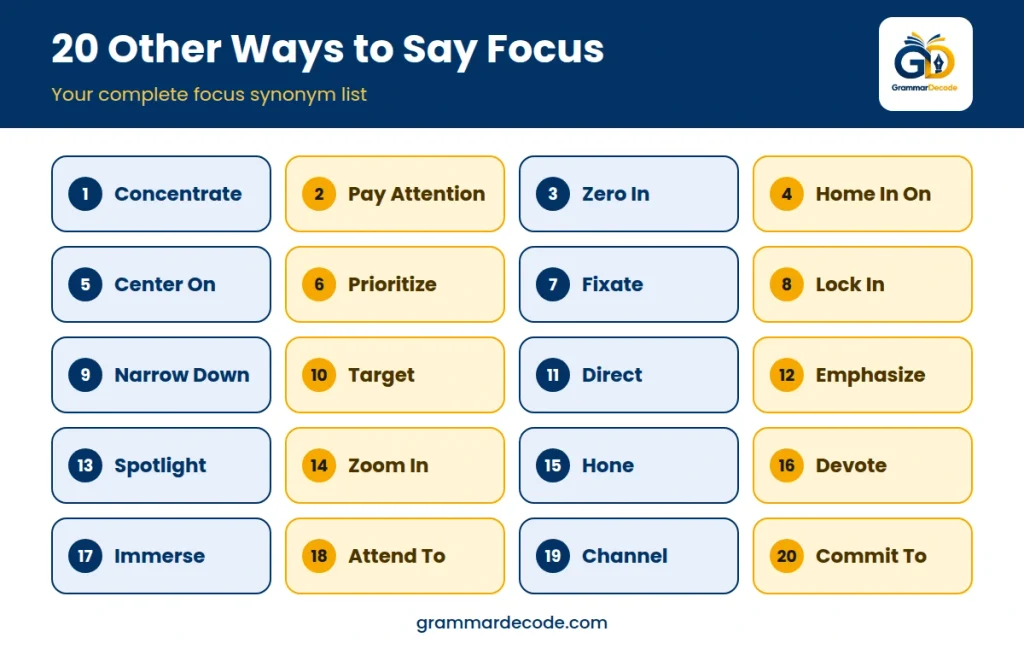
Here’s the full list. Each entry includes what the word means, how it feels in a sentence, and where it works best.
1. Concentrate
Meaning: To direct all your mental effort toward one thing. Best for: Everyday writing, school, and work.
Examples:
- “It’s hard to concentrate when the neighbors are renovating.”
- “She closed her laptop so she could concentrate on the conversation.”
If you only remember one focus synonym from this list, make it this one. It’s safe, clear, and fits both casual and professional settings.
2. Pay Attention
Meaning: To notice and listen carefully to something. Best for: Classrooms, parenting, and general conversation.
Examples:
- “If you pay attention to the first five minutes, the rest will make sense.”
- “He wasn’t paying attention, so he missed the announcement.”
It’s a bit softer than “focus” and sounds very natural when you’re talking to someone directly.
3. Zero In
Meaning: To move your attention toward one specific target. Best for: Problem-solving, analysis, and meetings.
Examples:
- “Let’s zero in on the real reason sales dropped.”
- “The editor zeroed in on a single weak paragraph.”
This one has a bit of energy to it. It suggests you’re cutting through the noise and getting to the point.
4. Home In On
Meaning: To move steadily closer to a specific point or goal. Best for: Research, investigation, and detailed work.
Examples:
- “The team is homing in on a solution.”
- “She homed in on the key detail in the report.”
A quick tip: the correct phrase is “home in,” not “hone in.” Many people mix them up, and getting it right quietly boosts your credibility.
5. Center On
Meaning: To make something the main point or theme. Best for: Essays, presentations, and formal writing.
Examples:
- “The discussion centered on climate policy.”
- “Her research centers on early childhood education.”
This is a smooth replacement when “focus” is acting as a verb describing a topic or theme.
6. Prioritize
Meaning: To treat something as more important than other things. Best for: Workplaces, planning, and productivity talk.
Examples:
- “You’ll need to prioritize your health this year.”
- “We’re prioritizing customer feedback in the next update.”
Use it when the idea is about choosing what matters most, not just paying attention.
7. Fixate
Meaning: To become stuck on something, often too much. Best for: Describing obsessive or unhealthy attention.
Examples:
- “Try not to fixate on one bad grade.”
- “He fixated on the tiny mistake for days.”
Heads up: this one usually carries a negative feeling. It’s “focus” with a worried frown.
8. Lock In
Meaning: To commit your full attention, usually in a determined way. Best for: Casual talk, sports, and motivation.
Examples:
- “Okay, time to lock in and finish this project.”
- “He locked in during the final quarter.”
This is very informal and very modern. Great for social media or friendly chats, but maybe skip it in a formal report.
9. Narrow Down
Meaning: To reduce a wide set of options to a smaller group. Best for: Decisions, searches, and planning.
Examples:
- “We narrowed down the candidates to three.”
- “Let’s narrow down the topic before we start writing.”
It works as a focus synonym when “focus” means limiting your scope.
Read: LMY Meaning Explained: What It Stands For and How to Use It
10. Target
Meaning: To aim your efforts at a specific person, goal, or result. Best for: Marketing, business, and strategy.
Examples:
- “The campaign targets first-time homebuyers.”
- “We’re targeting a 15 percent increase this quarter.”
Clear, strong, and very common in professional writing.
11. Direct
Meaning: To point your attention or effort toward something. Best for: Formal and semi-formal writing.
Examples:
- “She directed her energy toward learning Spanish.”
- “Please direct your questions to the help desk.”
It sounds calm and controlled, which makes it a nice fit for polished writing.
12. Emphasize
Meaning: To give special importance to something. Best for: Speeches, essays, and persuasive writing.
Examples:
- “The teacher emphasized the importance of practice.”
- “The report emphasizes long-term growth over quick wins.”
Use this when “focus” really means “highlight.”
13. Spotlight
Meaning: To draw public attention to something. Best for: Journalism, blogging, and marketing.
Examples:
- “The documentary spotlights small farmers.”
- “This month’s newsletter spotlights our volunteers.”
It has a bright, engaging feel, and readers tend to love it.
14. Zoom In
Meaning: To look more closely at a specific detail. Best for: Explanations, tutorials, and creative writing.
Examples:
- “Let’s zoom in on the second chart.”
- “The author zooms in on one family’s story.”
It gives readers a mental picture, almost like a camera lens, which is a neat nod to the original meaning of focus.
15. Hone
Meaning: To sharpen or refine a skill over time. Best for: Career, learning, and personal growth.
Examples:
- “She spent the summer honing her writing skills.”
- “He honed his craft through years of practice.”
It’s perfect when you’re talking about improving something, not just paying attention to it.
16. Devote
Meaning: To give your time or energy fully to something. Best for: Formal writing and heartfelt statements.
Examples:
- “He devoted his weekends to the community garden.”
- “She devoted herself to her studies.”
There’s an emotional warmth here that “focus” doesn’t always carry.
17. Immerse
Meaning: To become deeply involved in something. Best for: Learning, creative work, and storytelling.
Examples:
- “He immersed himself in his research.”
- “The best way to learn a language is to immerse yourself in it.”
Use it when the attention isn’t just sharp, but deep.
18. Attend To
Meaning: To deal with something carefully and give it proper care. Best for: Professional and formal settings.
Examples:
- “Please attend to the urgent requests first.”
- “The nurse attended to each patient with care.”
A slightly old-fashioned but elegant option for business emails.
19. Channel
Meaning: To direct your energy or resources toward a specific purpose. Best for: Motivational writing, interviews, and personal stories.
Examples:
- “She channeled her frustration into her art.”
- “We should channel our resources into fixing the app.”
This one suggests that energy has somewhere productive to go.
20. Commit To
Meaning: To dedicate yourself seriously to something. Best for: Goals, resumes, and personal statements.
Examples:
- “I’m committed to improving my time management.”
- “The company committed to a single product line.”
It’s the focus synonym to reach for when you want to show real determination.
Formal vs. Informal Ways to Say Focus
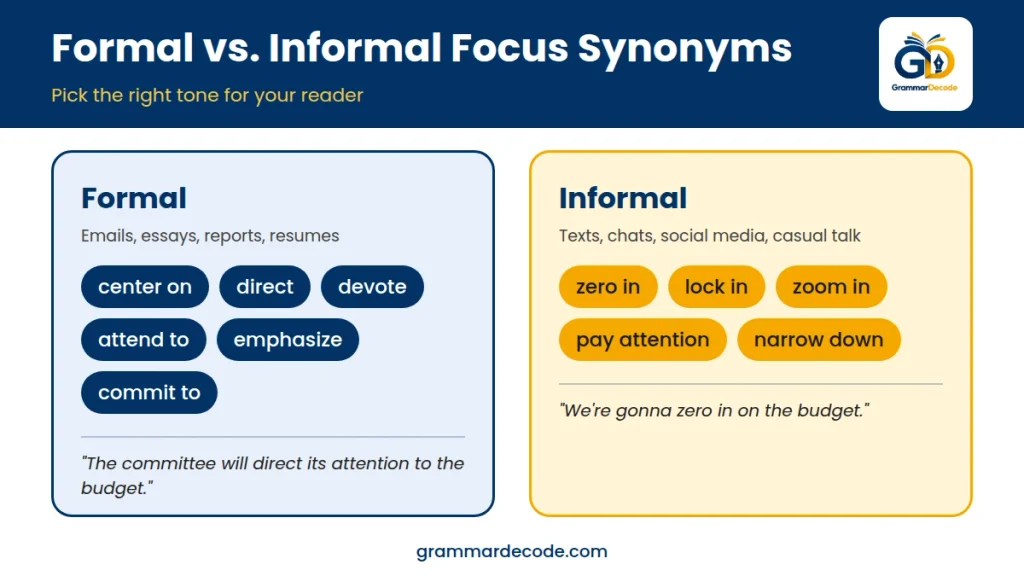
Tone matters more than most people think. The same idea can sound totally different depending on the word you choose.
Formal alternatives: center on, direct, devote, attend to, emphasize, commit to
Informal alternatives: zero in, lock in, zoom in, pay attention, narrow down
Quick example:
- Formal: “The committee will direct its attention to the budget.”
- Informal: “We’re gonna zero in on the budget.”
Both say the same thing. One fits a boardroom, the other fits a coffee break.
Read: Reply of Take Care of Yourself: Best Responses for Every Situation
Focus Synonyme for the Noun Form
What if “focus” is a noun in your sentence? Here are some solid replacements:
- Center: “The center of the debate was funding.”
- Core: “The core of her argument was simple.”
- Heart: “This is the heart of the problem.”
- Priority: “Safety is our top priority.”
- Emphasis: “The school places great emphasis on reading.”
- Hub: “The city is a hub of innovation.”
- Main point: “What’s the main point of your essay?”
These are especially handy in academic writing, where “focus” can show up as a noun again and again.
Words That Mean the Opposite of Focus
Understanding the opposite can sharpen your sense of the word. Common antonyms include:
- Distract
- Ignore
- Neglect
- Scatter
- Wander
- Overlook
For instance: “His mind wandered during the lecture” is the exact opposite of “He concentrated during the lecture.”
Common Mistakes When Using Focus Synonyme
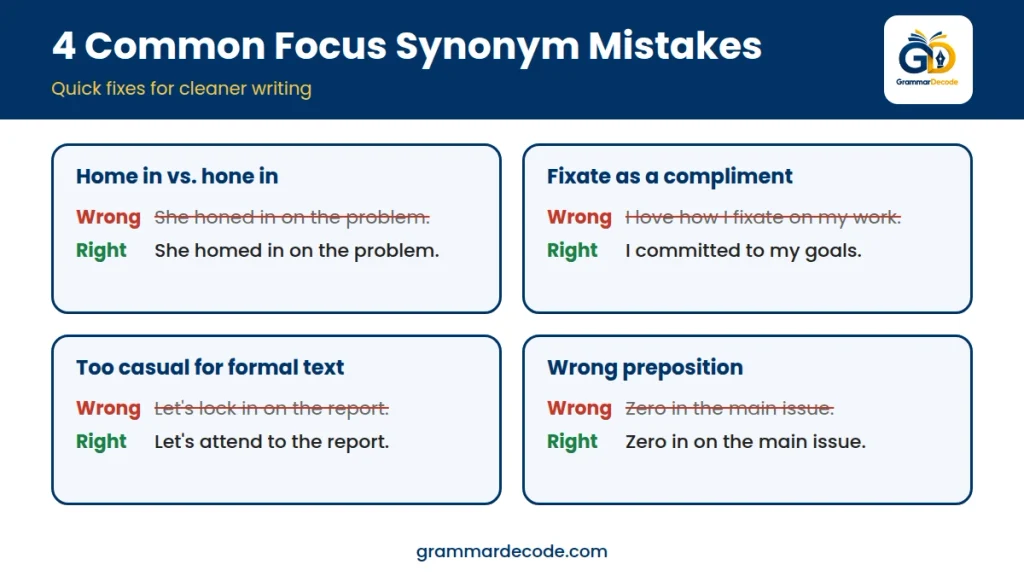
Swapping words is easy. Swapping them well takes a little care. Watch out for these slip-ups:
- Mixing up “home in” and “hone in.” “Home in” is the standard form for moving toward a target.
- Using “fixate” as a compliment. It usually hints at too much attention, so it can sound critical.
- Being too casual in formal writing. “Lock in” won’t land well in a legal document.
- Forgetting the preposition. You focus on something, you concentrate on something, you zero in on something. Small words matter.
- Overdoing it. If every sentence has a fancy replacement, the writing feels forced. Mix synonyms with the original word for a natural rhythm.
Tips for Choosing the Right Focus Synonyme
Stuck between two options? Ask yourself these quick questions:
- Who’s reading this? A teacher, a boss, or a friend?
- What exactly do I mean? Attention, priority, or emphasis?
- How does it sound out loud? If it feels awkward to say, it probably reads awkwardly too.
- Does it fit the sentence structure? Some words need “on,” some need “to,” and some need nothing at all.
A good habit is to read the sentence aloud once before you commit. Your ear usually catches what your eye misses.
Frequently Asked Questions About Focus Synonyms
What is the best focus synonym?
“Concentrate” is usually the best all-around choice. It’s clear, natural, and fits almost any context. For more specific meanings, “prioritize,” “emphasize,” or “zero in” may suit you better.
What is a professional way to say “focus”?
Try “prioritize,” “direct,” “attend to,” or “center on.” All of them sound polished in emails, reports, and resumes.
What is a casual way to say “focus”?
“Lock in,” “zero in,” “zoom in,” and “pay attention” all feel relaxed and conversational.
Is “focus synonyme” the same as “focus synonym”?
Yes. “Focus synonyme” is just a different spelling people often type when searching, especially non-native English speakers. In English, the correct spelling is synonym, and it simply means a word with a similar meaning.
Final Thoughts on Focus Synonyms
Words are small, but they shape how people hear you. Swapping one repeated word for a better-fitting focus synonym can make your writing feel fresher, clearer, and a lot more human.
You don’t need to memorize all 20. Pick three or four that feel like you, practice them in your next email or essay, and let the rest sit in your back pocket for when you need them. Over time, your vocabulary grows naturally, one useful word at a time.
And hey, if this guide helped, take a look at more word-choice tips and synonym lists here on GrammarDecode. There’s plenty more where this came from.