22 Other Ways to Say EXPLAIN | Explain Synonyms with Examples
The word explain is commonly used in everyday conversations, academic writing, and professional communication. However, repeating the same word can make your writing sound less interesting. Using a suitable explain synonym can help you express your thoughts more clearly and improve your vocabulary.
Words like clarify, describe, illustrate, and demonstrate are useful alternatives to explain. Each word has a slightly different meaning and can be used in different situations. Choosing the right one makes your sentences more natural and effective.
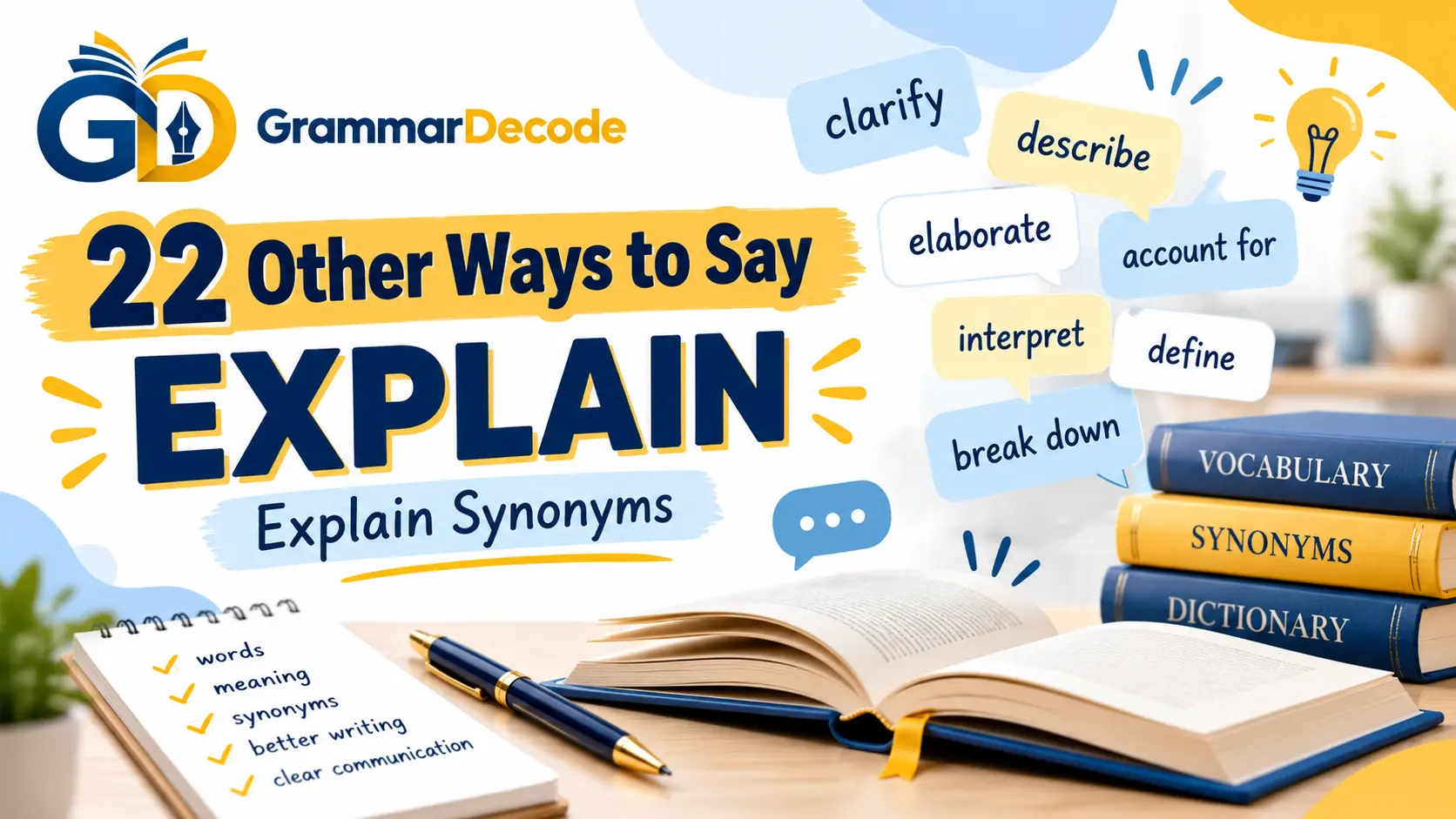
In this article, we will explore 22 other ways to say explain, along with their simple meanings and example sentences. You will also learn how to use these synonyms for explain correctly in everyday conversations, essays, and professional writing.
What Does Explain Mean?
The word explain means to make something clear or easy for another person to understand. It involves giving information, details, examples, or reasons about a topic, situation, or idea.
People use explain when they want to help others understand how something works, what something means, or why something happened.
Examples:
- The teacher explained the lesson using simple examples.
- Can you explain why the meeting was canceled?
- She explained how to complete the online form.
An explanation can be short or detailed, depending on the situation. Choosing a suitable synonym for explain helps you communicate your exact meaning.
Read: 200+ Science Words That Start With Y With Simple Meanings & Examples
22 Explain Synonyms With Meanings and Examples

There are many synonyms for explain, but not all of them work in the same situations. Some are helpful when giving details, while others are better for showing examples, removing confusion, or providing reasons.
Here is a quick comparison of 22 alternatives.
| Synonym | Simple Meaning | Best Used For |
|---|---|---|
| Clarify | Make something easier to understand | Removing confusion |
| Describe | Give details about something | People, places, and events |
| Illustrate | Explain using examples or pictures | Teaching and writing |
| Demonstrate | Show how something works | Practical instructions |
| Elaborate on | Give additional details | Discussions and presentations |
| Spell out | Explain something very clearly | Rules and instructions |
| Break down | Divide a difficult idea into smaller parts | Complex topics |
| Walk through | Guide someone step by step | Processes and tutorials |
| Outline | Give the main points | Plans and summaries |
| Define | State the meaning of something | Words and concepts |
| Interpret | Explain what something means | Literature and information |
| Detail | Give specific information | Reports and procedures |
| Articulate | Express thoughts clearly | Opinions and ideas |
| Set out | Present information in an organized way | Formal documents |
| Clear up | Remove confusion or doubt | Misunderstandings |
| Make clear | Help someone understand | Everyday communication |
| Shed light on | Provide useful information | Questions and mysteries |
| Elucidate | Make a difficult idea clearer | Formal and academic writing |
| Expound on | Explain a topic in great detail | Lectures and discussions |
| Explicate | Explain through careful analysis | Academic texts |
| Account for | Explain the cause of something | Reasons and results |
| Justify | Give reasons to support something | Decisions and actions |
22 Other Ways to Say Explain (With Examples)
Let’s look at these alternatives in more detail. Each word has a particular use, so understanding the differences will help you choose the right one.
1. Clarify
Meaning: To make something clear by removing confusion or misunderstanding.
Clarify is one of the most useful alternatives to explain. It is commonly used when someone does not fully understand a message, question, or instruction.
You can use this word in classrooms, meetings, emails, and everyday conversations.
Examples:
- The teacher clarified the instructions before the exam.
- Could you clarify what you mean by that statement?
- She clarified the new rules during the meeting.
When to use it: Choose clarify when information has already been shared but needs to be made clearer.
2. Describe
Meaning: To tell someone what something is like by giving important details.
The word describe is useful when talking about a person, place, object, experience, or event. It helps listeners imagine or understand what you are discussing.
Unlike explain, which often focuses on how or why something happens, describe usually focuses on what something is like.
Examples:
- She described her first day at university.
- The witness described the accident to the police.
- Can you describe the problem you are facing?
When to use it: Use describe when providing details about appearance, features, events, or experiences.
3. Illustrate
Meaning: To make an idea easier to understand by using examples, pictures, or diagrams.
Illustrate is a helpful synonym for explain in education and writing. Teachers and writers often use examples to make difficult information easier to follow.
This word is especially useful when you want to support an idea with something practical.
Examples:
- The teacher illustrated the concept with a simple diagram.
- She illustrated her argument using real-life examples.
- The chart illustrates how sales changed over the year.
When to use it: Choose illustrate when examples, visuals, or comparisons help explain your point.
4. Demonstrate
Meaning: To show clearly how something works or how an action is performed.
Demonstrate is often used when someone teaches a process through actions or examples. Instead of only telling people what to do, you show them.
This word is common in classrooms, training sessions, workplaces, and practical lessons.
Examples:
- The instructor demonstrated how to use the new machine.
- The chef demonstrated the correct way to prepare the dish.
- She demonstrated the process using a simple experiment.
When to use it: Use demonstrate when teaching through actions, practical examples, or visible results.
5. Elaborate On
Meaning: To explain something further by adding more information or details.
When someone gives a short answer, you may ask them to elaborate on it. This means you want a more complete explanation.
The phrase is useful in interviews, discussions, academic writing, and professional conversations.
Examples:
- Could you elaborate on your idea for the project?
- The speaker elaborated on the benefits of the new system.
- She asked him to elaborate on his previous answer.
When to use it: Choose elaborate on when you want additional information about something already mentioned.
6. Spell Out
Meaning: To explain something very clearly so that nothing important is misunderstood.
Spell out is a common phrase in everyday English. It means providing information in a direct and detailed way.
It is useful when someone needs clear instructions, rules, or expectations.
Examples:
- The manager spelled out the responsibilities of each employee.
- Please spell out the steps we need to follow.
- The agreement clearly spells out the payment terms.
When to use it: Use spell out when you need to make instructions or details completely clear.
7. Break Down
Meaning: To explain a difficult topic by dividing it into smaller, easier parts.
Break down is especially helpful when discussing complicated information. It makes a difficult subject easier to understand by focusing on one part at a time.
You will often hear this phrase in teaching, business discussions, and tutorials.
Examples:
- The teacher broke down the math problem into simple steps.
- Can you break down the report for beginners?
- She broke down the process so everyone could follow it.
When to use it: Choose break down when explaining complicated ideas in a simple, step-by-step way.
8. Walk Through
Meaning: To guide someone through a process by explaining each step.
Walk through is a friendly and practical alternative to explain. It is often used when helping someone complete a task.
In this meaning, we commonly say walk someone through something.
Examples:
- The instructor walked us through the registration process.
- Can you walk me through how this website works?
- She walked the new employees through the safety procedure.
When to use it: Use walk through for tutorials, instructions, software demonstrations, and practical guidance.
9. Outline
Meaning: To explain the main points of something without giving every detail.
Outline is useful when you want to provide a quick overview of a plan, idea, or topic.
Instead of explaining everything, you focus on the most important information.
Examples:
- The teacher outlined the main topics of the lesson.
- He outlined his business plan during the presentation.
- The guide outlines the steps required to apply.
When to use it: Choose outline when giving a summary or introducing the main parts of a topic.
10. Define
Meaning: To explain the exact meaning of a word, phrase, or concept.
Define is commonly used in schools, dictionaries, research, and academic discussions. It helps people understand what a particular word or idea means.
However, defining something is usually more specific than giving a full explanation.
Examples:
- The teacher asked students to define the word “communication.”
- Can you define this scientific term in simple English?
- The document clearly defines the responsibilities of each team member.
When to use it: Use define when explaining the meaning or boundaries of a word or concept.
11. Interpret
Meaning: To explain the meaning of something based on your understanding or analysis.
Interpret is often used when discussing poems, stories, artwork, messages, and information that may have different meanings.
It involves looking beyond the words or details to understand what they represent.
Examples:
- The teacher interpreted the poem for the students.
- She interpreted the results of the experiment.
- Different readers may interpret the story differently.
When to use it: Choose interpret when explaining the meaning of information, language, art, or events.
12. Detail
Meaning: To give complete or specific information about something.
As a verb, detail means to describe or explain something carefully by including important facts and details.
It is especially useful in reports, instructions, plans, and professional documents.
Examples:
- The report detailed the causes of the problem.
- She detailed the steps required to complete the task.
- The manager detailed the company’s plans for the coming year.
When to use it: Use detail when providing specific information rather than a general explanation.
Read: Science Words That Start With J: Meanings and Examples
13. Articulate
Meaning: To express ideas, thoughts, or feelings clearly and effectively.
Articulate is a useful word when someone communicates their thoughts in a well-organized way.
It is often used in formal speaking, interviews, essays, and professional discussions.
Examples:
- She articulated her opinion during the meeting.
- The student articulated his ideas clearly.
- He found it difficult to articulate his concerns.
When to use it: Choose articulate when emphasizing how clearly someone expresses an idea.
14. Set Out
Meaning: To explain or present information clearly in an organized way.
Set out is commonly used in formal writing, instructions, contracts, and reports. It means arranging important facts or ideas so readers can understand them easily.
Examples:
- The document sets out the rules for the competition.
- She set out her reasons for making the decision.
- The guide sets out the steps for completing the application.
When to use it: Use set out when presenting information in a clear, structured format.
15. Clear Up
Meaning: To remove confusion, misunderstanding, or uncertainty.
Clear up is a natural phrase in everyday English. It is similar to clarify and is often used when something has caused confusion.
It can refer to misunderstandings, unclear instructions, or unanswered questions.
Examples:
- The teacher cleared up the confusion about the assignment.
- I called the office to clear up a misunderstanding.
- His explanation cleared up my doubts.
When to use it: Choose clear up when resolving confusion or correcting a misunderstanding.
16. Make Clear
Meaning: To help someone understand something without confusion.
Make clear is a simple alternative to explain. It is especially useful when you want to communicate an important fact, rule, or point directly.
This phrase works well in both everyday and professional English.
Examples:
- The teacher made the instructions clear to everyone.
- She made it clear why the deadline was important.
- The announcement made clear what students needed to bring.
When to use it: Use make clear when emphasizing that information should be easy to understand.
17. Shed Light On
Meaning: To provide information that makes a confusing or unknown subject easier to understand.
Shed light on is a common expression used when new facts help explain a situation or answer a question.
You may see it in news articles, research papers, and discussions.
Examples:
- The investigation shed light on the cause of the accident.
- The research sheds light on how children learn languages.
- Her interview shed light on the challenges faced by new employees.
When to use it: Choose shed light on when providing new information or insight into something unclear.
18. Elucidate
Meaning: To make a complicated or difficult idea easier to understand.
Elucidate is a formal synonym for explain. It is mostly used in academic, scientific, and professional writing.
Although it has a similar meaning to clarify, it sounds more formal and is less common in everyday conversation.
Examples:
- The researcher elucidated the causes of the unexpected results.
- The professor used examples to elucidate the difficult theory.
- The report helps elucidate the relationship between the two factors.
When to use it: Use elucidate in formal writing when explaining complex subjects.
19. Expound On
Meaning: To explain an idea or topic carefully and in great detail.
Expound on is a formal expression used when someone gives a long or detailed explanation of a subject.
It is commonly found in lectures, academic discussions, and professional presentations.
Examples:
- The professor expounded on the importance of education.
- She expounded on her views about environmental protection.
- The speaker expounded on the theory during the conference.
When to use it: Choose expound on when discussing a topic thoroughly, especially in formal situations.
20. Explicate
Meaning: To explain the meaning of something through careful analysis.
Explicate is another formal alternative to explain. It is often used when analyzing poems, literature, theories, or complex ideas.
It focuses on making a subject understandable by examining its meaning and details.
Examples:
- The professor explicated the meaning of the poem.
- The article explicates the main ideas of the theory.
- She carefully explicated the author’s argument.
When to use it: Use explicate in academic writing, literary analysis, and detailed discussions of complex texts.
21. Account For
Meaning: To explain why something happened or give the reason for a situation.
Account for is useful when discussing causes, results, actions, or unexpected events.
Unlike some other alternatives, this phrase focuses mainly on explaining reasons rather than describing information.
Examples:
- The manager accounted for the delay by describing the technical problem.
- How do you account for the sudden increase in prices?
- The scientist tried to account for the unusual results.
When to use it: Choose account for when explaining the reason behind an event, decision, or result.
22. Justify
Meaning: To give reasons or evidence to show why an action, belief, or decision is reasonable or acceptable.
Justify is related to explain, but the meanings are not exactly the same. When you justify something, you do more than explain it. You also provide reasons to support it.
This word is common in debates, essays, workplace discussions, and decision-making.
Examples:
- She justified her decision with clear evidence.
- The manager justified the additional expenses.
- He tried to justify his actions during the discussion.
When to use it: Use justify when defending a decision or showing why something is reasonable.
What Is the Best Synonym for Explain?
The best synonym for explain depends on what you want to communicate.
If your goal is to make confusing information easier to understand, clarify is usually a good choice. If you want to give more information, elaborate on may be more suitable.
Here are some common situations:
| Situation | Recommended Alternative | Example |
|---|---|---|
| Making an unclear idea easier to understand | Clarify | Could you clarify your answer? |
| Giving additional information | Elaborate on | Please elaborate on your proposal. |
| Showing how something works | Demonstrate | Can you demonstrate the process? |
| Making a difficult subject simpler | Break down | Break down the lesson into smaller parts. |
| Giving step-by-step instructions | Walk through | Walk me through the setup process. |
| Explaining the meaning of a term | Define | Define the word in simple English. |
| Explaining the cause of an event | Account for | How do you account for the delay? |
| Supporting a decision with reasons | Justify | Can you justify your choice? |
Quick tip: If you are unsure which word to choose, clarify is often a helpful alternative when the goal is to improve understanding. However, the original word explain is still the most flexible choice in many situations.
Formal and Informal Synonyms for Explain
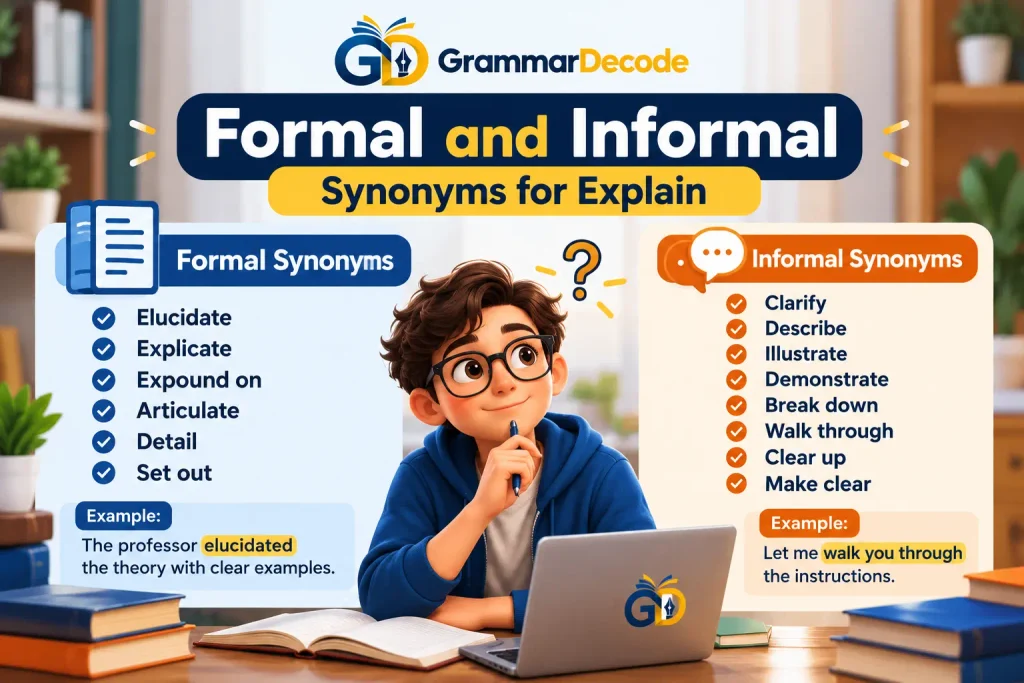
Some alternatives sound natural in casual conversations, while others are more suitable for essays, reports, and professional communication.
Formal Synonyms for Explain
Formal alternatives include elucidate, explicate, expound on, articulate, set out, and detail.
These words are useful in academic writing, business reports, research papers, and professional presentations.
Examples:
- The researcher elucidated the findings of the study.
- The document sets out the main objectives of the project.
- The author explicates the central argument in the final chapter.
Formal language can make your writing more precise, but using difficult words unnecessarily may make your message harder to understand.
Informal Synonyms for Explain
For everyday conversations, common alternatives include clear up, break down, walk through, spell out, and make clear.
These phrases sound friendly and natural when speaking with friends, classmates, or coworkers.
Examples:
- Can you break down this question for me?
- Let me walk you through the instructions.
- Could you clear up one thing before we begin?
Informal expressions are especially useful when you want to sound approachable and helpful.
Explain vs. Describe vs. Clarify: What’s the Difference?
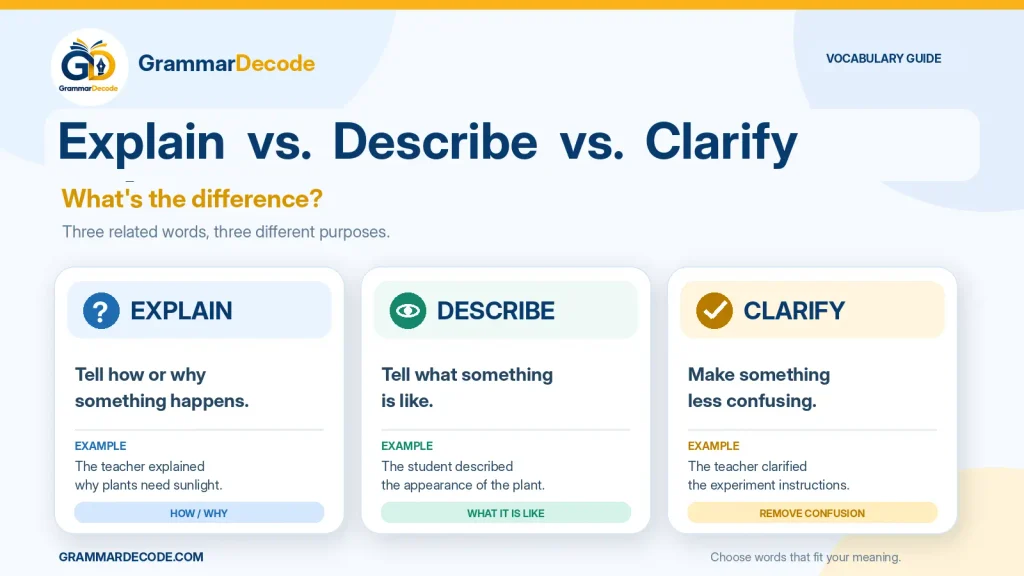
Although explain, describe, and clarify are related, they have different uses.
Explain focuses on helping someone understand how or why something happens.
Example: The teacher explained why plants need sunlight.
Describe focuses on giving details about what something is like.
Example: The student described the appearance of the plant.
Clarify focuses on removing confusion about information that is difficult to understand.
Example: The teacher clarified the instructions for the experiment.
A simple way to remember the difference is:
- Explain: Tell how or why.
- Describe: Tell what something is like.
- Clarify: Make something less confusing.
Understanding these differences will help you choose the right words in both speaking and writing.
Another Word for Explains: Different Verb Forms
If you are looking for another word for explains, remember that the replacement should match the grammar of your sentence.
The word explain is a verb, and its form changes depending on the subject and tense.
| Form of Explain | Possible Alternative |
|---|---|
| Explain | Clarify, describe, illustrate |
| Explains | Clarifies, describes, illustrates |
| Explained | Clarified, described, illustrated |
| Explaining | Clarifying, describing, illustrating |
| Explanation (noun) | Clarification, description, account |
These words have slightly different meanings, so choose the alternative that fits the sentence.
For example:
Original: The teacher explains the lesson clearly.
Alternative: The teacher clarifies the difficult parts of the lesson.
Original: The guide explains how to register.
Alternative: The guide walks readers through the registration process.
Original: The report explains the reasons for the change.
Alternative: The report sets out the reasons for the change.
Notice that changing the verb may also require changing the rest of the sentence.
Common Mistakes When Using Explain Synonyms
Learning new vocabulary is helpful, but using the wrong word can change your intended meaning.
Here are some common mistakes to avoid.
1. Using Describe When You Mean Explain Why
Incorrect meaning: She described why the machine stopped working.
Better: She explained why the machine stopped working.
Describe is normally used to give details, while explain is better when giving reasons or causes.
2. Using Elaborate Without the Correct Preposition
Incorrect: Could you elaborate about your idea?
Better: Could you elaborate on your idea?
The phrase elaborate on is a natural way to ask someone for additional details.
3. Confusing Explain and Justify
Explain: He explained why he arrived late.
Justify: He tried to justify arriving late.
The first sentence gives a reason. The second suggests that he is trying to show his behavior was acceptable.
4. Using Difficult Words in Simple Conversations
Unnecessarily formal: Could you elucidate the homework instructions?
More natural: Could you clarify the homework instructions?
Both sentences are understandable, but clarify sounds more natural in everyday English.
How to Choose the Right Explain Synonym
Choosing the correct word becomes easier when you consider your purpose and audience.
Think about what you want to communicate. Are you giving details, answering a question, showing a process, or explaining a decision?
Consider who will read or hear your message. Simple words like clarify and describe are usually suitable for everyday conversations. More formal words like elucidate and explicate may fit academic writing.
Check the meaning before replacing a word. Two words can be similar without being interchangeable in every sentence.
Keep your language clear. A familiar word used correctly is often better than a complicated word that makes your message confusing.
The purpose of using synonyms is not simply to make your writing different. It is to help readers understand your message more accurately.
Frequently Asked Questions About Explain Synonyms
What is another word for explain?
Common alternatives to explain include clarify, describe, illustrate, demonstrate, elaborate on, and spell out. The best choice depends on whether you want to provide details, remove confusion, or show how something works.
What is the closest synonym for explain?
Clarify is one of the closest synonyms when you want to make information easier to understand. However, explain has a broader meaning, so no single alternative works in every sentence.
What is another word for explains?
Other words for explains include clarifies, describes, illustrates, demonstrates, details, and outlines. For example, “The teacher explains the process” can become “The teacher demonstrates the process” when the teacher shows how it works.
What is a formal way to say explain?
Formal alternatives include elucidate, explicate, expound on, and articulate. These words are useful in essays, academic discussions, professional reports, and presentations when their specific meanings fit the context.
Final Thoughts
Using different words for explain can make your speaking and writing clearer, more natural, and more engaging. The right word depends on whether you are giving details, removing confusion, showing an example, or providing reasons.
If you need an explain synonym for everyday communication, words like clarify, describe, illustrate, and demonstrate are excellent starting points. For more formal writing, alternatives like elucidate, expound on, and explicate may be appropriate.
Remember that every synonym has its own meaning and purpose. Choose words that fit your sentence rather than replacing explain simply to avoid repetition.
With these 22 other ways to say explain, you can improve your vocabulary, communicate more confidently, and express your ideas with greater precision.